
Martano: Churches, Palaces and Salentine Culture
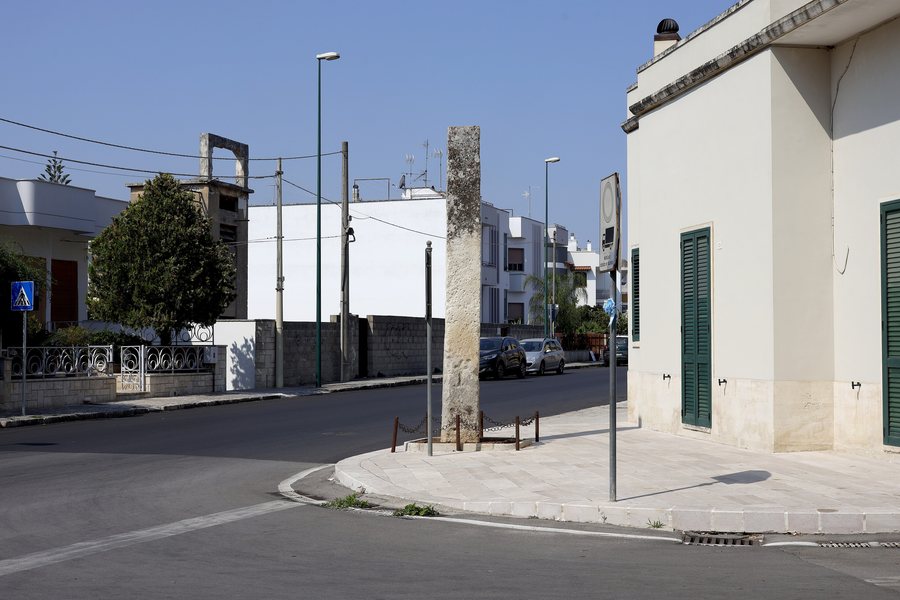 File:Menhir del Teofilo, IX-VII sec. a.C. Martano, Lecce, Puglia -FG3.jpg
Photo: Fabrizio Garrisi via Wikimedia Commons, CC BY-SA 4.0
File:Menhir del Teofilo, IX-VII sec. a.C. Martano, Lecce, Puglia -FG3.jpg
Photo: Fabrizio Garrisi via Wikimedia Commons, CC BY-SA 4.0
Martano combines a well-preserved historic center with churches, aristocratic palaces, archaeological traces and events.
Historic center with palaces and old streets
The oldest part of Martano, known as Terra, is distinguished by its good state of preservation and a regular orthogonal street network. In the center, the Palazzo Baronale follows the course of Via Guglielmo Marconi. Its surviving architectural elements include decorated windows, a portal with rusticated masonry and the sloping base of a cylindrical tower. The palace was rebuilt by the Aragonese after the reconquest of Otranto; the surviving tower dates from the Aragonese period.
Several other palaces reveal Martano’s architectural history through individual façade details. Palazzo Moschettini was built between 1710 and 1720. Above its magnificent portal is a long balcony supported by seven corbels. Palazzo Grassi-Corina has a portal-balcony-coat-of-arms ensemble, as well as an openwork balcony supported by six elaborately designed corbels. At Palazzo Micali, built in 1719, the long balcony is likewise supported by six corbels; a statue of Saint Michael stands on the central capital of the bifora.
Churches and archaeological traces
The Chiesa Matrice, dedicated to the Assumption of Mary, was rebuilt in 1596 and replaced an earlier church of the Greek rite. The Chiesa Matrice dell’Assunta also contains valuable paintings attributed to Oronzo Tiso and Cesare Fracanzano. The church of Santa Maria della Consolazione retains its original appearance. Its main altar dates from 1691; above it, a fresco of the Virgin of Consolation is preserved in an oval frame.
Martano also bears the religious heritage of various periods. The Church of San Domenico was built or rebuilt in 1652 and has three naves with 18th-century altars. The Convento di Santa Maria della Consolazione, built in the 17th century, stands on the site of an old chapel of the Byzantine rite named Madonna del Ligori. The Cistercian monastery of Santa Maria della Consolazione includes a 17th-century church, a library and a picture gallery.
In the area of Martano, on the border with the countryside of Zollino, lies Casale di Apigliano. The archaeological site preserves remains from several periods and numerous finds. A village already existed there in the 8th century. The remains of rural dwellings and various everyday objects bear witness to life in the Byzantine period. The church of Santa Maria, also widely known as the Church of San Lorenzo, has also survived from the ancient Casale di Apigliano.
The menhir of Santu Totaru is also called the Teofilo Menhir; the prehistoric monument is associated with ancient religious rituals of the Japygian peoples at the beginning of the Iron Age, from the 9th to the 7th century BC. The Specchia dei Mori lies on the road from Martano to Martignano, about 1 km outside the town.
Open-air culture and events
The Museo diffuso delle Sculture in pietra leccese transforms the streets and squares of Martano into an open-air tour dedicated to the culture of local stone. Cortili Aperti is an annual event held in Martano. During the event, lanes, squares, courtyards and inner courtyards with churches and palaces are opened to visitors through exhibitions, concerts, artistic performances, culinary routes and cultural events.
During La Notte della Taranta, groups performing folk singing and Salentine music appear in the streets and squares of Martano. The Sagra de la volìa cazzata in Martano is dedicated to crushed olives. Martano’s underground oil mill used a grinding basin with a millstone, presses and settling pits to produce olive oil.
Connections to destinations in Salento
Martano’s main railway station mainly offers connections to nearby towns, including major tourist destinations in Salento such as Lecce, Gallipoli and Galatina.
Other places: Torre Pali, Seclì, Tuglie, Sanarica, Villaggio Resta, Veglie, Torre Chianca and Diso.
More about Lecce: Lecce.
Check prices, availability and amenities for your travel dates directly on Booking.com.
View accommodations and offersAdvertisement · Affiliate link to Booking.com
