
Montesano Salentino: Churches, Vineyards and Padula Mancina
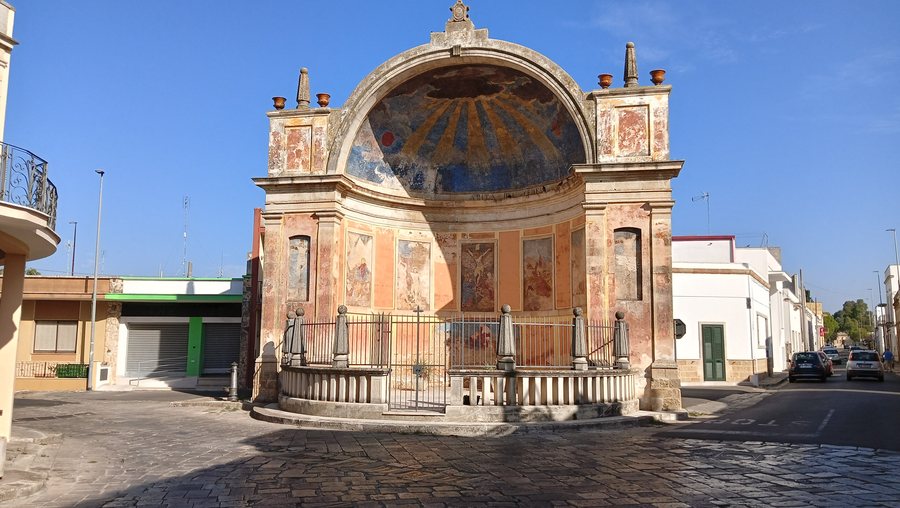
Montesano Salentino combines sacred history, rural culture and a diverse landscape. A particularly distinctive place is the Calvario, built in 1870 and located along the central route connecting the mother church with the medieval sanctuary of San Donato. Its design recalls the apse of an imaginary church: the road forms the nave, the façades along the side streets resemble the side walls, and the blue sky serves as a vault. In this way, an everyday town space becomes a unique architectural experience.
Churches and historic townscapes
The Cappella di San Donato adds to this sacred setting. The present building dates from 1775; according to tradition, its origins go back as far as the 15th century. The Chiesa Maria SS. Immacolata also reflects several construction phases. It is a 16th-century building that was extensively remodelled in 1822. Above its Baroque portal stands a stone statue of the Virgin Mary. Inside, there is also a Venetian wooden statue of San Donato dating from the 17th century.
The historic townscape also includes the ancient courtyards in the centre. They are examples of rural Salento architecture. Palazzo Bitonti stands in Piazza IV Novembre. This historic building, dating from 1821, reflects the aristocratic past of Montesano Salentino. The palmenti, meanwhile, form part of the town’s historical heritage and rural culture. They consist of eight large basins and reflect traditional forms of rural life.
Festivals of religious and local significance
The festival of San Donato is particularly closely associated with the Cappella di San Donato. It takes place on 6 and 7 August in the chapel dedicated to the saint in Montesano Salentino. During the festival, the statue of the saint, normally kept in the parish church, is carried to the chapel. In the past, many people came to Montesano Salentino to seek San Donato’s intercession for the healing of illnesses.
The traditional Fiera Mercato di San Donato is also held on 7 August. Typical food products and local handicrafts are offered there. Another regular date is the festival in honour of San Luigi, celebrated on the third Saturday in June. These dates combine religious traditions with everyday local life and regional culture.
Wetland, trail and wine-growing landscape
West of Montesano Salentino, towards Ruffano, lies Padula Mancina, a 2.5-hectare wetland and marsh area. It is a remnant of a larger marshland that has since been mostly drained. The area consists of a pond, is regularly flooded by rainwater channelled in through canals, and is of particular natural interest. Alongside the churches and historic buildings, this brings a distinctly different landscape theme into focus.
The Paduli Trail passes through Montesano Salentino and five other municipalities in the southern Salento: Nociglia, Miggiano, Taurisano, Ruffano and Specchia. The townscape is complemented by extensive vineyards surrounding Montesano Salentino. When choosing a hotel, you can therefore shape the focus of your trip around sacred history and festivals, rural culture, or landscapes and trail experiences. The “Salvatore Scolozzi” municipal library provides the public with information and lending services and has rooms for conferences and other cultural activities.
Other places in the same area
For further orientation, you can also explore Veglie, Novoli, Fontanelle, Gemini, Torre San Giovanni, Vignacastrisi, Marina di Marittima and Campi Salentina.
For the broader travel overview: Lecce.
Check prices, availability and amenities for your travel dates directly on Booking.com.
View accommodation and offersAdvertisement · Affiliate link to Booking.com
