
Poggiardo: History and Landscape in Salento
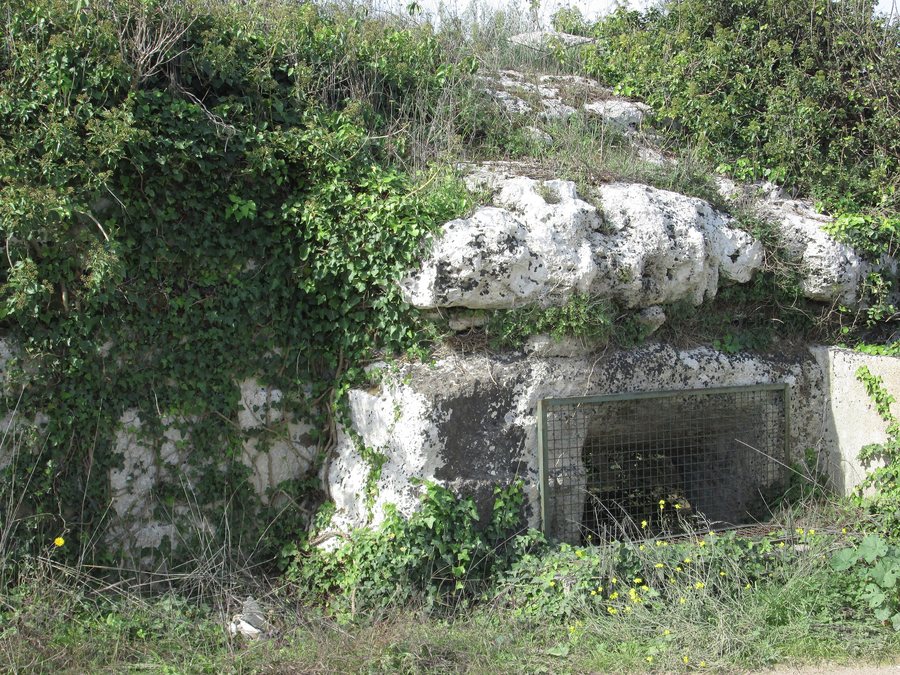
Poggiardo combines impressive religious buildings, historic palazzi and archaeological evidence with a landscape of pine trees, olive trees, caves and reddish soil. If you are looking for a place for your trip to Italy where cultural history and observing nature can be combined, the town offers various points of interest for this.
Religious Buildings and Historic Town Centre
The Chiesa Matrice di San Salvatore is the oldest religious building in Poggiardo. Its origins date back at least to the 14th century, while the façade acquired a typically Baroque style in the 18th century. Inside, the church has a single-nave layout with a Latin-cross floor plan and three deep chapels. The ceiling is decorated with frescoes and Baroque stucco work.
Another historic layer of Poggiardo can be seen in the Cripta di Santa Maria degli Angeli. It is located in the town centre beneath Via Don Minzoni, near the Chiesa Madre and the Palazzo Ducale dei Guarini. The crypt is one of Poggiardo's oldest monuments; the old settlement developed around it in early times. At the same time, it is an example of the underground churches and crypts characteristic of Salento in the area around Otranto.
The Palazzo Guarini was initially built in the mid-14th century as a military building with primarily defensive and surveillance functions. A large round tower characterises the structure. In the 15th century, the palazzo was gradually transformed from a fortified complex into a magnificent noble residence. The former moat was filled in and converted into a citrus grove. On Piazza Episcopo, the so-called „Sentinelle“ also shape the appearance: small towers that give the square its own architectural character.
Vaste and the Messapian Past
Vaste, a district of Poggiardo, is an important archaeological site that bears witness to the Messapian civilisation. The Museo Archeologico della Civiltà Messapica is housed in the 16th-century Palazzo Baronale on Piazza Dante. Its exhibition is arranged chronologically and ranges from places of worship from the Archaic and Hellenistic periods to the Middle Ages. This creates a chronological sequence in which the history of the site can be viewed across several eras.
The Parco dei Guerrieri di Vaste extends across more than 20 hectares from the settlement of Vaste to the Serre of Poggiardo and includes evidence of Messapian culture. At the entrance are faithful replicas of the Ipogeo delle Cariatidi. From the terrace, you can view the remains of the ancient circuit wall. This area is particularly interesting if you are interested in archaeological traces not in isolation, but in connection with the landscape and the history of the settlement.
Pine Trees, Caves and Paths through the Landscape
The Pineta dei Marirossi comprises a 16-hectare man-made forest and numerous caves. Pine trees and olive trees grow there alongside wild orchids. The reddish colour of the soil is largely due to rich bauxite deposits, which are no longer exploited today. This combination of vegetation, rock and former use gives the landscape its distinctive character.
The Grotta Marirossi is also known as the „Grotta che respira“. At the entrance, it has a continuous flow of air. Villa Episcopo complements the landscape with a garden, small paths and numerous plants typical of the Mediterranean region, as well as small picturesque caves. Together with the pine forest, this creates a range of different natural features, from Mediterranean vegetation to underground cavities.
A path begins northwest of the Pineta dei Marirossi, connecting natural landscapes with traces of industrial archaeology and leading to the Querceto dei Reali. This connection is particularly interesting for your planning if you want to experience nature not merely as a backdrop, but also in interaction with the historic traces of human use. The landscape around Poggiardo can therefore be explored through individual locations as well as thematic connections.
Travel Information
For exploring the area south of Otranto, the FSE railway station in Poggiardo can be used as a rail connection. Thus, alongside the historic sights, getting around is also part of sensible travel planning. Depending on your focus, you can regard Poggiardo as a culturally oriented destination, a starting point for exploring Messapian history, or a place of particular interest for its landscape and industrial archaeology.
Further destinations for your planning: Vignacastrisi, Collemeto, Bagnolo Del Salento, Muro Leccese, Torre Saracena, Alliste, Torre Dell'orso, Diso
For the main travel overview: Lecce.
Check prices, availability and amenities for your travel dates directly on Booking.com.
View Accommodation and OffersAdvertisement · Affiliate link to Booking.com
