
Santa Maria al Bagno between beach, memory and marine life
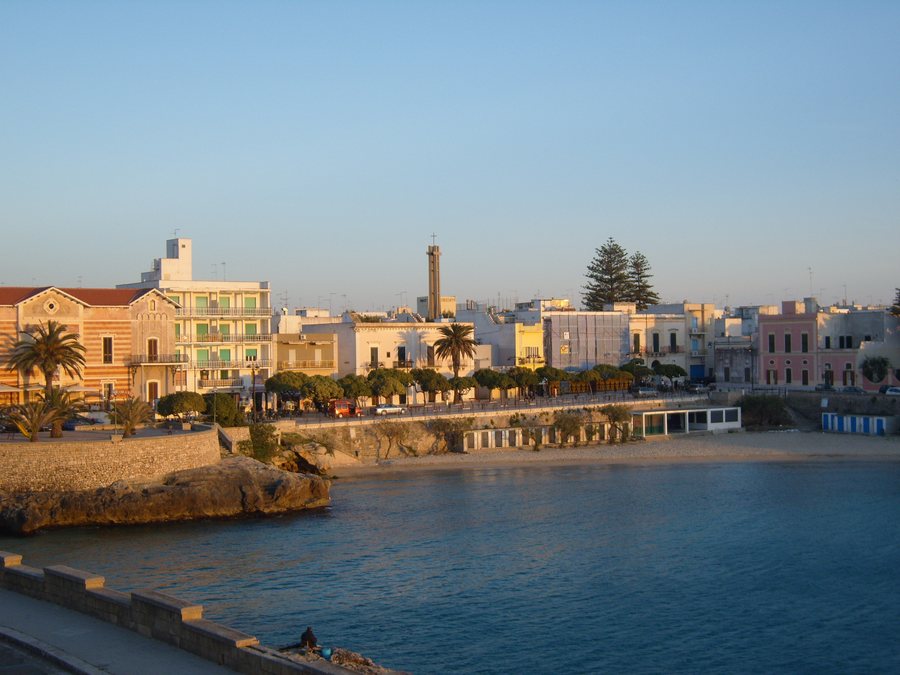
Santa Maria al Bagno combines the coast with a culture of remembrance and insights into the marine world of Salento. The sandy beach lies on Nardò’s low, rocky coast between Lido Conchiglie and Santa Caterina.
Sandy beach and rocky coast
The sandy beach of Santa Maria al Bagno is no more than 150 metres long; steps lead to it from the piazza of the coastal town of the same name. This short stretch can be considered a separate beach section when planning the day. The access is therefore directly within the townscape of Santa Maria al Bagno and not away from the coastal town.
Near the Quattro Colonne there are small pools carved into the rock; there is also a fully equipped bathing establishment there. Water sports, scuba diving and boat trips are offered in the beach area. The sandy beach, rock pools and bathing establishment therefore belong to the same coastal area, while these offerings cover different ways of spending time by the sea.
Remembering the history of the town
The Museo della Memoria e dell’Accoglienza preserves evidence of the reception camps set up in the area by the Allies. In Santa Maria al Bagno and its immediate vicinity, such a camp received thousands of Jewish people between 1943 and 1947.
The history room of the Museo della Memoria e dell’Accoglienza also preserves original murals by Zvi Miller, which are considered the only surviving graphic testimony of Aliyah Bet in Europe. The murals are therefore part of the museum’s collection just as the evidence relating to the reception camps is.
The museum offers a ticket option for a guided tour of the museum and Santa Maria al Bagno. Daily visits to the Museo della Memoria e dell’Accoglienza are organised around the time slots 9:30–12:30 and 15:30–19:30; reservations are required. The two time slots divide the museum visit into a morning or afternoon block.
Towers and marine life
Another piece of evidence along the coast is the Torre del Fiume Galatena. Its central section probably collapsed shortly after its construction; today, the four towers known as the “Quattro Colonne” are visible. The name Quattro Colonne thus refers to the four towers of the complex that are visible today.
The original complex had a square, truncated-pyramid-shaped structure with pentagonal corner bastions and was approximately 16 metres high. The features described therefore include both the ground plan and the shape of the bastions, as well as the approximate height.
The Acquario del Salento houses the permanent photographic exhibition “Gaspare e altre creature dello Ionio” and presents the local marine fauna typical of Salento, including fish, crustaceans, molluscs and echinoderms. The exhibition combines photographic depictions with these specific groups of marine fauna.
Four exhibition rooms guide visitors along a route from sea level to a depth of 100 metres; both a cave environment and an open-sea environment are included. The route thus extends from the surface to a significantly deeper marine area and includes both environments.
More places for planning your trip
Other places you can consider for planning your trip include Porto Badisco, Racale, Morciano Di Leuca, Presicce, Marina di Marittima, Conca Specchiulla, Depressa and Zollino.
For the higher-level travel overview: Lecce.
Check prices, availability and amenities for your travel dates directly on Booking.com.
View accommodation and offersAdvertisement · Affiliate link to Booking.com
