
Soleto: Frescoes, Churches and Griko Tradition
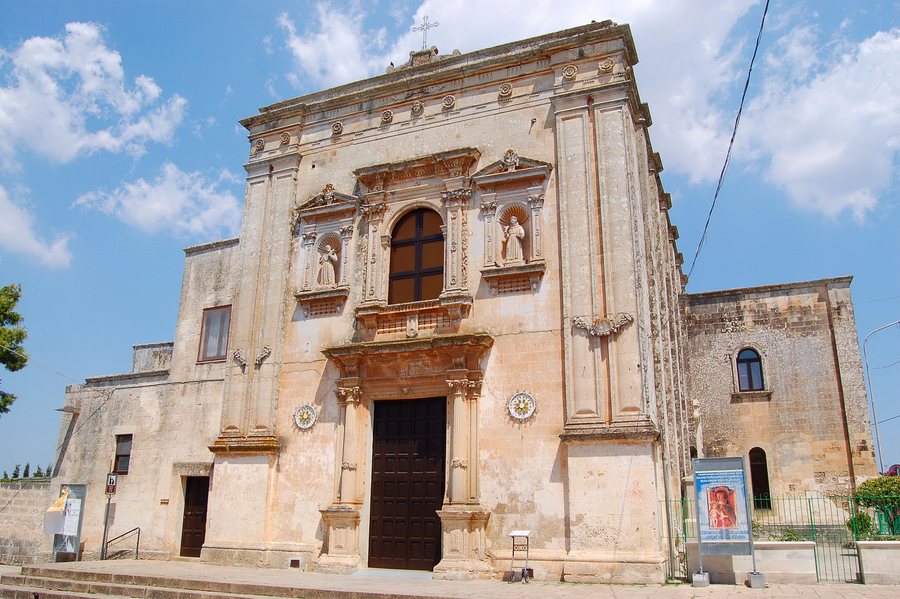 File:Madonna delle Grazie, church in Soleto, Italy.jpg
Photo: Michael Paraskevas via Wikimedia Commons, CC BY-SA 3.0
File:Madonna delle Grazie, church in Soleto, Italy.jpg
Photo: Michael Paraskevas via Wikimedia Commons, CC BY-SA 3.0
Soleto between Griko tradition and stone-built testimonies
Soleto lies in the heart of Grecìa Salentina. In this area, the ancient Griko dialect of Hellenophonic origin is still kept alive. Soleto was an important centre, especially during the 14th and 15th centuries.
A historic centre with a visible history
The Porta di San Vito is the eastern and only surviving gate of Soleto’s former city walls. Originally, there were four gates: San Vito to the east, San Antonio to the north, San Gaetano to the west and San Paolo to the south.
Today, Soleto’s historic centre is encircled by the Raimondello Orsini bypass. It follows the route of the old city walls, which, according to De Giorgi, were rebuilt in the 17th century.
Churches, frescoes and religious history
The Chiesa di Santo Stefano was probably built in 1347 by an unknown founder. Until the end of the 16th century, it was an important Italo-Greek religious and cultural centre. Its walls are covered with heavily damaged Byzantine frescoes. The paintings are arranged in overlapping horizontal bands and accompanied by Greek inscriptions.
The Cappella Madonna di Leuca was rebuilt in the 18th century on the ruins of an older church with an unknown dedication. Its central wall features a fresco from 1766 depicting the crowned Madonna di Leuca in a purple robe on grey clouds, together with the Christ Child. The Cappella Madonna di Leuca is also located along the Via Francigena. The building is attributed to the 18th century, while the artwork is dated to 1766.
The Chiesa Parrocchiale was built in 1783 by Adriano Preite from Copertino and replaced a demolished medieval church. Inside is a marble baptismal font from the 14th century, intended for immersion according to the Eastern rite. The baptismal font therefore dates from an earlier period than the church in which it is located.
The Chiesa di San Nicola was rebuilt in 1648, used as a monastery of enclosure and consecrated in 1689 by the Archbishop of Otranto, Monsignor Ferdinando De Aguinar. A painting from 1726 on the presbytery wall depicts Saint Nicholas and his four miracles. The painting therefore dates from the period after the consecration of the rebuilt building.
Palazzo Gervasi and the Guglia Orsiniana
The elegant Palazzo Gervasi is a 16th-century palace and now houses the municipal library. The building also contains a large fireplace dating from 1588, which can be viewed by visitors. Palazzo Gervasi thus combines its present-day municipal use with a preserved architectural detail from 1588.
Rising above the townscape is the 45-metre-high Guglia Orsiniana. It is considered a landmark of Soleto and is one of Italy’s national monuments.
To the main travel overview: Lecce.
Check prices, availability and amenities for your travel dates directly on Booking.com.
View accommodation and offersAdvertisement · Affiliate link to Booking.com
