
Torre Dell'orso: Coast, Nature and Traces of History
Torre Dell'orso combines a striking coastal landscape with tangible traces of its past. If you would like to combine the sea, nature and culture on your trip to Italy, you will find a variety of points of interest here: the nearly one-kilometre-long bay, paths along the coast, natural rock formations, wetlands and historical evidence. When choosing your hotel, you can therefore consider whether the landscape, activity by the water or the history of this stretch of coast should be your main focus.
The bay between sand, dunes and pine forest
The bay of Torre Dell'orso stretches for nearly one kilometre between two cliffs and has fine sand. Its landscape is characterised by low dunes and a dense pine forest inland. Two natural rock towers rise in front of the bay: Le Due Sorelle. The two rock towers are among the defining features of this stretch of coast, without their name implying anything further about their present condition or a specific use.
Coastal paths and views by the water
Le Due Sorelle can be reached on foot from Torre Dell'orso beach via a somewhat steep path over uneven terrain. A coastal walking route also leads to the Punta Matarico headland. When planning your visit, you therefore have the choice between the bay's fine sand and the somewhat steep path over uneven terrain.
Boat trips along the Apulian coast
One boat trip continues in the direction of Otranto and can sail around Le Due Sorelle. Another boat trip starts at the marina of San Foca in Melendugno and explores otherwise inaccessible places, rocky coastlines and sandy bays. Together, these two options offer a view of the coast from the water: one trip takes in the rock formations and the direction of Otranto, while the other combines its departure from San Foca with various coastal landscapes.
Brunese, pine forest and wetlands
The landscape is also varied away from the open bay. The Brunese freshwater canal runs through a pine forest, flows into the sea and is home to fauna and wetlands along its course. The canal thus adds a habitat to the picture of the coast, where forest, freshwater, sea and wetland areas are directly connected. For travellers interested in nature, the value of this place lies precisely in this combination of different landscape elements.
Watchtower and ancient traces
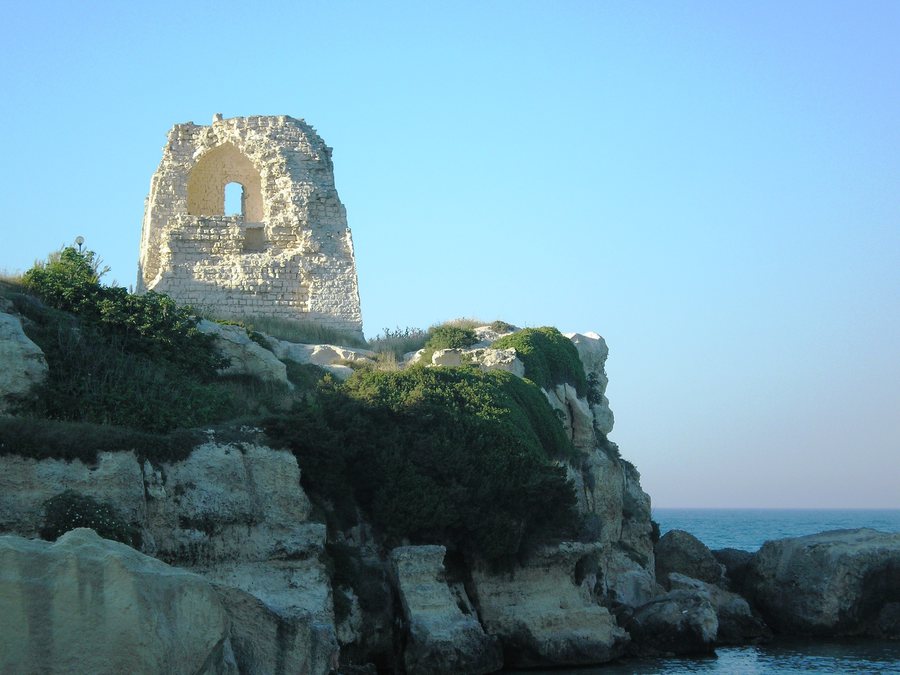
The coastal watchtower of Torre Dell'orso survives as a ruin with substantial losses caused by the erosion of the stone. Its former function was to observe and warn of dangers to the nearby towers of Sant'Andrea and Roca Vecchia, as well as to the settlements in the immediate hinterland. The ruin thus represents the historical task of keeping watch over this stretch of coast and its hinterland.
Several invocations to unidentified ancient deities were found in the Grotta di San Cristoforo. One inscription mentions Felicior Hispanus, who asks a deity for a safe crossing of the strait without fear. Together with the watchtower, these testimonies give the coast a historical depth that clearly differs from the natural scenery of the bay, pine forest and rock formations.
More travel ideas
For more travel ideas, you can also take a look at Borgagne, Scorrano, Alessano, Ugento, Palmariggi, Castrignano Del Capo, Vernole and Marittima.
For the overarching travel overview: Lecce.
Check prices, availability and amenities for your travel dates directly on Booking.com.
View accommodation and offersAdvertisement · Affiliate link to Booking.com
.JPG)