
Matera between the Sassi, museums and Murgia
Accommodation in Matera
Matera reveals itself through the combination of settlement history carved into the rock, museums housed in historic cave spaces and landscape experiences in the Murgia. The UNESCO World Heritage site “The Sassi and the Park of the Rupestrian Churches of Matera” provides the city with its distinctive historical setting.
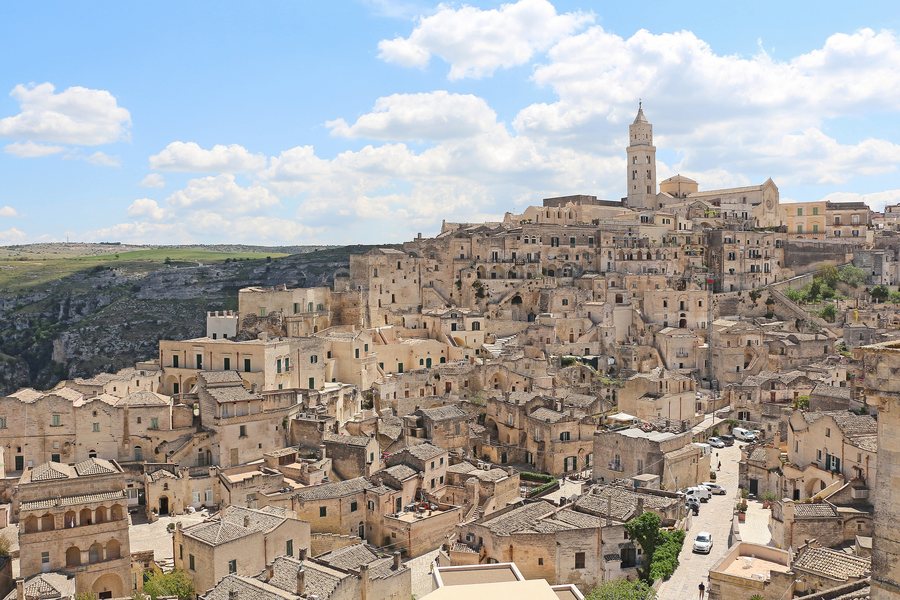
The Sassi and history carved into the rock
The UNESCO World Heritage site “The Sassi and the Park of the Rupestrian Churches of Matera” includes houses, churches, monasteries and hermitages built into the natural caves of the Murgia. It is an outstanding example of a settlement carved into the rock, with continuity documented over more than two millennia. In Matera’s historic centre, the two districts of Barisano and Caveoso have been preserved.
Museums in historic spaces
MUSMA presents Italian and international sculpture from the late 19th century to the present day. The museum’s collection is displayed in the 16th-century Palazzo Pomarici in the heart of Matera’s Sassi. The Museo Laboratorio della Civiltà Contadina is an ethnological and anthropological museum in Matera’s historic Sassi district. It is housed in a subdivided 16th-century Lamione that extends into a network of various pre-existing caves.
The Museo Archeologico nazionale Domenico Ridola documents more than 400 predominantly carved wooden objects in its ethnographic collection. In addition, 11 hypogeal structures discovered in Contrada Ciccolocane in Matera provide important archaeological evidence of the social organisation of the time. Casa Noha presents a multimedia video reconstructing Matera’s history from its origins to the present day.
Cisterns, rock churches and historic landmarks
From the 16th century onwards, the Palombaro Lungo was created in several construction phases as an artificial cavity. It has a capacity of 5 million litres, a depth of 16 metres and a length of 50 metres. Beneath Piazza Vittorio Veneto, the Palombaro Lungo is a large cistern for collecting water. It can be visited via convenient footbridges above the water.
The Cripta del Peccato Originale was the place of worship of a Benedictine rock monastery from the Lombard period. It contains a fresco cycle from the 8th and 9th centuries painted by the artist known as the “Painter of the Flowers of Matera”. The Cripta del Peccato Originale can be visited by prior reservation. Jazzo Gattini is an old 19th-century sheepfold and houses a visitor centre.
Exploring the Murgia on foot and by bicycle
The Municipality of Matera recommends exploring the Sassi and the surrounding Murgia on foot. In the Parco della Murgia Materana, the Gravina di Matera is a geological gorge that is of particular interest to visitors. Birdwatching, especially searching for birds of prey and other birds, is one of the activities available to visitors in the park. Mountain biking is also offered on narrow paths connecting old farmsteads with rock settlements.
Sentiero 406 and Murgia Timone
The Sentiero 406 connects Matera’s Sassi with the Murgia Timone plateau via a panoramic route that includes a footbridge over the Gravina stream. The Sentiero 406 begins at Porta Postergola. Porta Postergola is also known as Porta Pistola. The route thus connects historic urban areas with a landscape where hiking, birdwatching and mountain biking offer different ways to experience the Murgia.
Other places in the surrounding area
Metapont, Tinchi, Bernalda, Lido Di Scanzano, Pisticci, Ferrandina, Pomarico, Montalbano Jonico
To the higher-level travel overview: Matera.

_02.jpg)