
Montescaglioso: History, Landscape and Lucanian Tradition
Accommodation in Montescaglioso
Montescaglioso is a destination for you if you would like to combine Lucanian tradition, medieval history and a landscape marked by archaeological traces in a single stay. The town presents these themes in different forms: through Cucibocca, the Norman castle, the history of San Michele Arcangelo Abbey and the extensive park with Mediterranean maquis, terraces and sites of geological significance. This allows you to plan cultural impressions alongside walks through a historically shaped landscape.
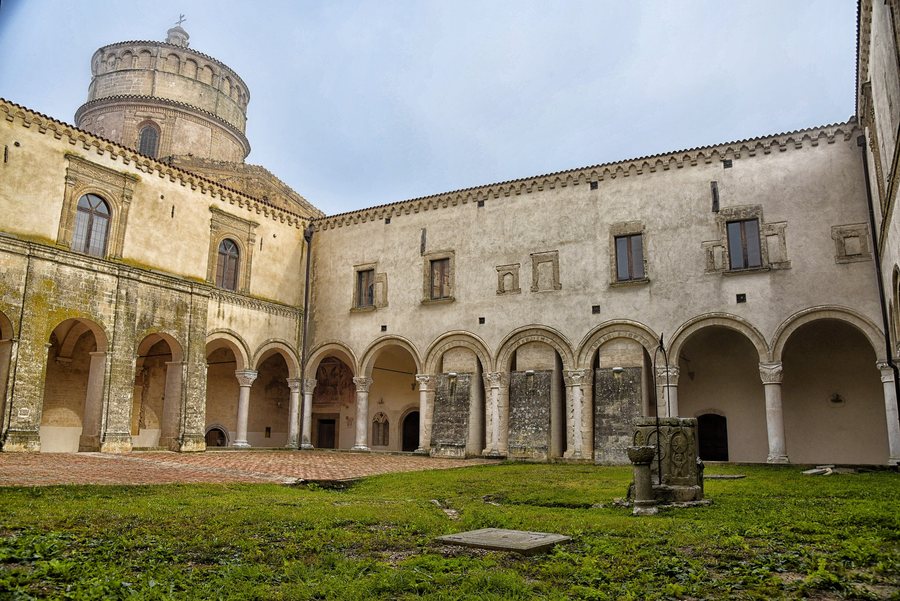 File:Abbazia Montescaglioso II chiostro.jpg
Photo: Anna Nicoletta Menzella via Wikimedia Commons, CC BY-SA 4.0
File:Abbazia Montescaglioso II chiostro.jpg
Photo: Anna Nicoletta Menzella via Wikimedia Commons, CC BY-SA 4.0
Lucanian Tradition and the History of the Town
The Cucibocca of Montescaglioso is an ancient and mysterious mask from the Lucanian tradition. Groups of figures move through the streets in dark clothing, wearing a wide cloak, a thick beard and chains on their feet. For you, this custom offers an unusual way of approaching the town’s cultural character, which does not need to be explained through a single attraction.
The Norman castle of Montescaglioso dates back to the 11th century. It was built to control Porta Maggiore, the most important of the town’s six entrances. The castle and Porta Maggiore are therefore historically connected through the control of an important access point.
The first written connection between Montescaglioso and a Benedictine presence in its territory dates back to 893. In 1099, the Church of San Lorenzo was documented as property of San Michele Arcangelo Abbey. Thus, the town’s religious history extends well beyond the visible buildings.
Ancient Traces in the Surrounding Area
The ancient sites in the immediate surroundings of Montescaglioso include Sant'Antuono/Santa Lucia-Belvedere and Masseria Modugno. Cugno La Volta is also considered an ancient site and is located near Montescaglioso. These three places complement the history of the castle and abbey with specific names for your cultural planning.
The Park Between Maquis and Archaeology
The park covers approximately 800 hectares and consists of terraces sloping down towards the sea, covered with dense Mediterranean maquis. The park contains the Calanchi di San Biagio and Lama dell'Inferno, which are considered sites of geological significance. For walks and nature observation, this combination of terraces, vegetation and geological formations offers a clear focus on the landscape.
A tratturo crossing the park has been restored and secured. In addition, a visitor route with paths, information panels and signs leading to the main archaeological zone has been established. The park’s archaeological and historical remains include an indigenous settlement from the 6th century BC, the Chapel of San Biagio, the remains of medieval sites and the Casone della transumanza. When planning your day, you can therefore choose between different focuses, including the landscape, paths and archaeological remains.
Getting to the Abbey
San Michele Arcangelo Abbey can be reached by private vehicle or by FAL buses. A self-guided visit to the abbey is offered as a visitor option. You can therefore plan this cultural focus individually and take your preferred form of transport into account.
Choosing a Hotel According to Your Interests
When choosing a hotel in Montescaglioso, you can first determine the focus of your stay: Cucibocca and the castle for Lucanian tradition and the history of the town, the abbey and San Lorenzo for the Benedictine legacy, or the park and visitor route for landscape and archaeology.
More Destinations
For further orientation, you can also consider Rotondella, Marina Di Pisticci, Irsina, Matera, San Giorgio Lucano, Marconia, Salandra and Metaponto.
For the higher-level travel overview: Matera.

