
Brienza Between History and Landscape
Accommodation in Brienza
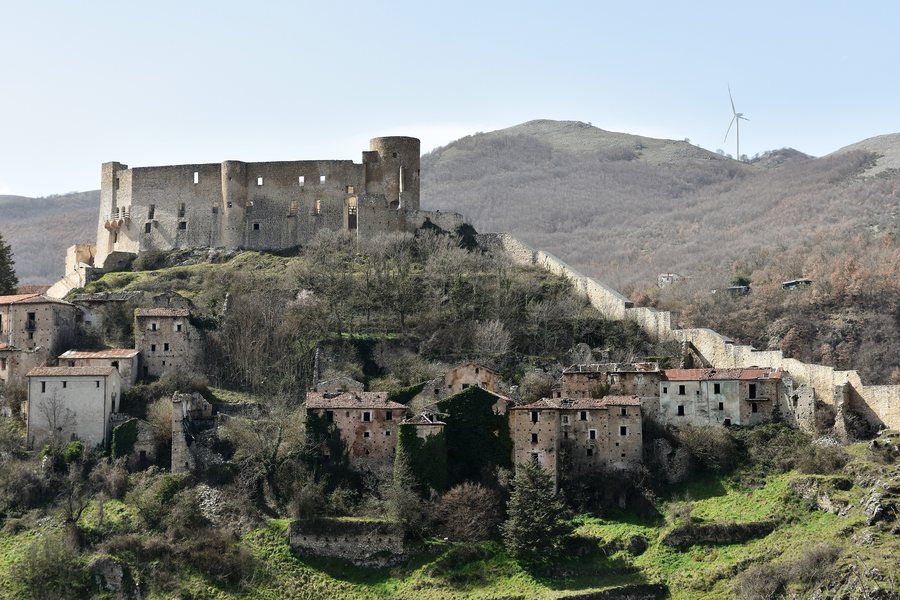
Brienza is a medieval village of remarkable historical and landscape significance. Located on a hill touched by the Pergola stream, between forests and mountains, the village lies within the Parco Nazionale dell’Appenino Lucano Val D’Agri Lagonegrese. Those who wish to experience historic townscapes and natural features together during a trip to Italy will find various specific points of interest in Brienza.
Alleys, Fortress and Historical Traces
Brienza has preserved its medieval structure with narrow alleys and winding paths. The historic fabric is therefore evident not only in individual buildings, but also in the layout of the paths and alleys. This creates a townscape in which the history remains immediately recognizable in the settlement structure.
Castello Caracciolo is a fortress of Angevin origin. A document from 1237 confirms the existence of the medieval Castello Caracciolo. The complex has a cylindrical keep and a semicircular turret within its surrounding walls. In Località Calata Prato, there is also a water mill with two upper floors and a basement, where the water wheel is still visible.
Sanctuary and Religious Tradition
The Santuario del SS.mo Crocifisso stands on the summit of the mountain of the same name, in an area surrounded by forests. Devotion to the Santuario del SS.mo Crocifisso in Brienza has existed since 1238. The religious tradition is therefore one of the long-standing themes through which the village can be understood.
The celebrations in honor of the SS.mo Crocifisso include an ascent ritual in May from Brienza’s mother church to the sanctuary on the Sacro Monte, as well as a descending return ritual in September from the mountain to the town.
Watercourses and Natural Monuments
The Pergola and Fiumicello watercourses form karst cavities known as “Marmitte dei giganti,” or giant kettles, and regarded as natural monuments of the village. The term giant kettles makes the distinctive shape of these geological cavities understandable even without specialized knowledge. Together with the location between forests and mountains and its inclusion in the national park, this creates a distinct landscape aspect alongside the medieval history of the village.
Literature and Lucanian Tradition
The Parco Letterario Francesco Mario Pagano includes a biobibliographical museum managed by the Centro Studi Internazionale “Francesco Mario Pagano” and containing more than 5,000 volumes. It is housed in the former convent of the Frati Minori Osservanti. For visitors interested in culture, this area combines the study of Francesco Mario Pagano, biographical content and an extensive collection of books.
Artisanal food production also has a firmly established history: since 2003, Genuino Burgentino has been producing artisanal sausages and other cured meats according to the Lucanian tradition. Thus, alongside the fortress, sanctuary, townscape and landscape, literature and regional artisanal production emerge in Brienza as distinct points of interest.
For more travel ideas, you can also explore San Martino D'agri, Missanello, Sarnelli, Campomaggiore, Avigliano, Tolve, Tito and Pietrapertosa.
To the main travel overview: Potenza.

