
Genzano di Lucania between history, art and farming traditions
Accommodation in Genzano Di Lucania
Genzano di Lucania combines a townscape shaped by history with sacred art, a landscape of springs and farming culture. The town is divided into two clearly distinct settlement areas: the higher-lying new district and the historic centre.
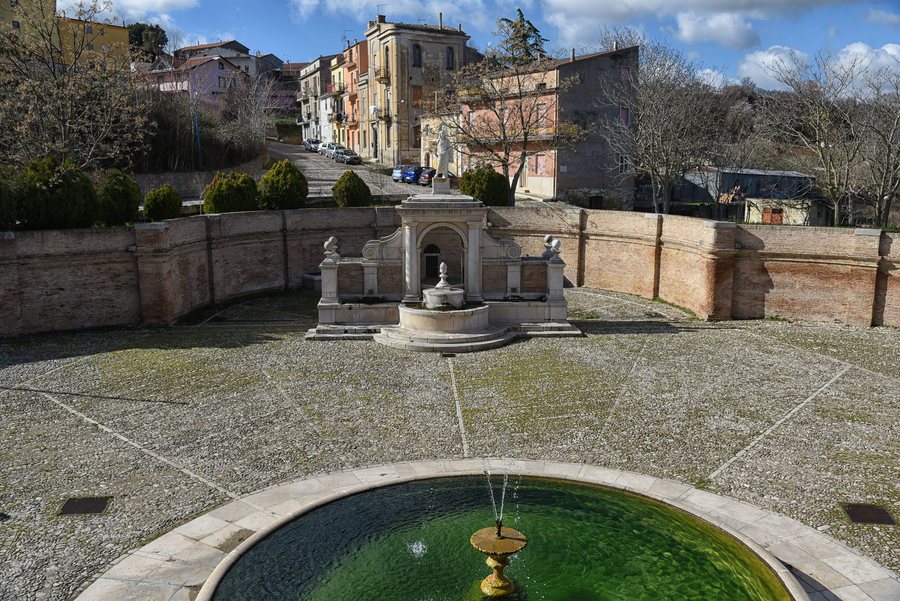 File:Genzano di Lucania fontana.jpg
Photo: Anna Nicoletta Menzella via Wikimedia Commons, CC BY-SA 4.0
File:Genzano di Lucania fontana.jpg
Photo: Anna Nicoletta Menzella via Wikimedia Commons, CC BY-SA 4.0
Art, Gates and Churches
The Fontana Cavallina was built between 1865 and 1893 in a fully neoclassical style. It features a statue of the goddess Ceres, which the inhabitants of Genzano call “Sand’Abbunnanza”. The statue of Ceres is an archaeological find dating from the 1st century BC to the 1st century AD. The Porta di Sant'Antonio is an old 17th-century gate leading to the historic centre of Genzano di Lucania. The Chiesa di Santa Maria della Platea houses a polyptych from the Aragonese period, attributed to the Venetian school, as well as an 18th-century wooden statue of the Madonna in Byzantine style, which can be viewed.
The Chiesa dell'Annunziata was built in the 16th to 17th century; its portal dates from the first half of the 16th century. The church is attached to the convent of the Poor Clares founded by Aquilina Sancia in 1321. The Chiesa e Monastero di S. Maria Annunziata complex is located in the oldest part of Genzano di Lucania, on a promontory surrounded by three deep ravines. The Chiesa del Sacro Cuore is a remodelled and smaller version of a former Franciscan monastery founded in 1630. It houses three 18th-century paintings depicting Saints Agatha, Lucy and Apollonia, signed D. G., as well as two panels from the 14th to 15th century depicting Saint Anthony and Saint Clare. The Chiesa del Carmine is located on the main street of the old town and is connected to the premises of the former monastery of the Discalced Carmelites.
Ravines, Springs and Views
The historic centre lies on a rocky spur surrounded by ravines on three sides. The Chiesa e Monastero di S. Maria Annunziata complex offers panoramic views of the ancient Fonte di Capo d'Acqua and Monte Vulture. Abundant clear and very fresh spring water emerges from the outlets of the Fonti di Capo d'Acqua. In 1954, a simple chapel was built at the Fonti di Capo d'Acqua near the place where a sacred image was found. A park was also created nearby as a place for relaxation and outdoor leisure.
Farming Culture and Local Character
The old crafts of Genzano's farming tradition are part of the intangible cultural heritage of Genzano di Lucania. The traditional farming techniques and crafts relate to the entire area, with a particular focus on the historic centre. The Museo della tradizione contadina at the Agricultural and Environmental Institute of Genzano di Lucania displays objects associated with local farming folklore. The economy is also typically agricultural and focuses on intensive wheat cultivation. Traditional activities included, among other things, kneading bread and preparing related products by housewives.
Another Historical Point of Interest
The nearby Castello di Monteserico is a classic example of medieval architecture. It has a central square tower, a lower surrounding wall and a moat. The castle was built during the Norman period and is located about 15 km from Genzano di Lucania. It thus complements the sacred and urban monuments with another historic building in the surrounding area.
More Destinations
For further travel planning, you can also include Potenza, Campomaggiore, Rionero In Vulture, Sant'arcangelo, Rapone, Sant'Angelo Le Fratte, Vaglio Basilicata and Corleto Perticara in your plans.
For the higher-level travel overview: Potenza.

