
Lagonegro: historic old town at Monte Sirino
Accommodation in Lagonegro
Lagonegro between its old town and mountain landscape
Lagonegro lies at the foot of Monte Sirino. The old town of Lagonegro is characterised by steep alleyways and houses leaning against the rock; next to it is the more modern district with a large square. This creates a townscape with a clear division between the historic area and the newer district. When planning your stay, you can consciously explore both sides one after the other: In the old town, the alleyways and houses leaning against the rock take centre stage, while the large square characterises the more modern district.
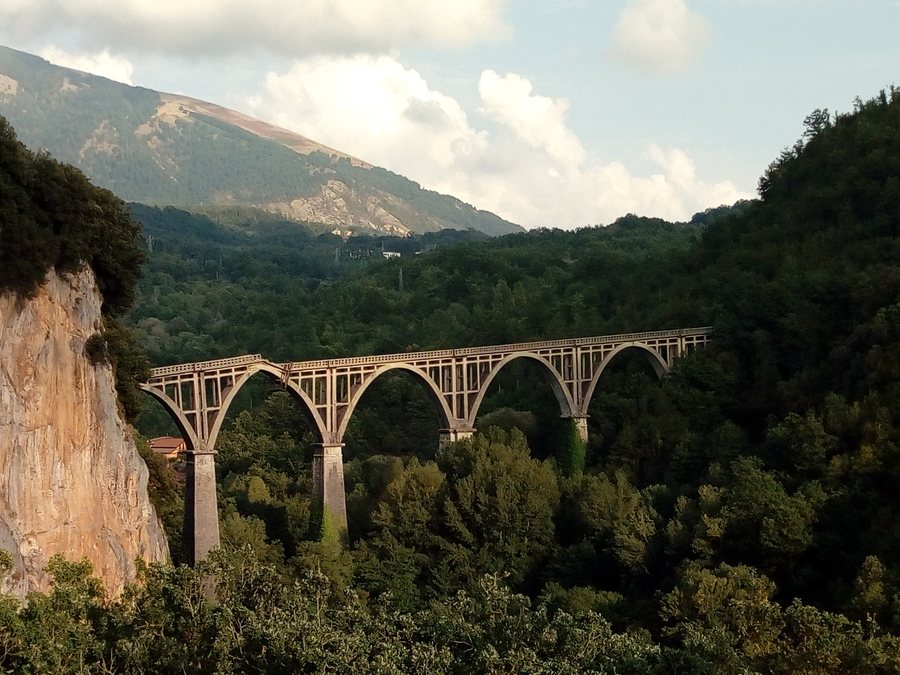 File:Ponte dello studente , Lagonegro.jpg
Photo: Minerva Vittoria via Wikimedia Commons, CC BY-SA 4.0
File:Ponte dello studente , Lagonegro.jpg
Photo: Minerva Vittoria via Wikimedia Commons, CC BY-SA 4.0
Access to the historic old town
The stepped access to the historic old town of Lagonegro was rebuilt in 1603 to replace the ancient drawbridge and leads to the Porta di ferro. The Porta di ferro is an entrance with a double arch. The church of San Nicola al Castello can be reached via a staircase through the Porta di ferro. Your walk therefore follows a clearly recognisable sequence of stepped access, gate and church, vividly conveying the historic character of this part of town.
Church and Convento di Santa Maria degli Angeli
The church of San Nicola al Castello was initially dedicated to San Cataldo and has been dedicated to San Nicola since 1572. The Convento di Santa Maria degli Angeli was established in the 9th century, when Basilian monks chose these slopes of the Lucanian Apennines as a place of prayer and refuge. The church and convent offer two different historical perspectives: The church preserves the change in its dedication, while the convent is associated with the prayer and refuge of the Basilian monks. If you would like to incorporate cultural history into your stay, you will encounter specific religious references and a clearly documented timeframe here.
A forest path to Nicola Molinari’s cave
A short forest path leads from the Convento di Santa Maria degli Angeli to a cave. The venerable Capuchin bishop Nicola Molinari, who lived from 1707 to 1792, withdrew to this cave to meditate and write ascetic works. The path and the cave are thus connected in a specifically described way with Nicola Molinari’s life. This section may be particularly interesting if you would like to explore religious history not only in churches but also in the landscape surrounding a town.
Lago Laudemio and a designated circular hike
Lago Laudemio is a glacial lake; it is also known as Remmo and lies on the northern slopes of the Sirino-Papa massif. The trekking route at Lago Laudemio is a 9.8 km circular hike with a walking time of approximately 5 hours and 30 minutes; it is designated for experienced hikers. If you include this tour in your stay, plan for a clearly defined hike with a longer walking time. The circular route and approximate duration provide a concrete framework for planning your day, while the designated target group should be taken into account when making your personal choice of tour.
Festa dell'Emigrante and San Nicola di Bari
The Festa dell'Emigrante includes a vigil at the ancient statue of Lagonegro’s patron saint, San Nicola di Bari. The statue is made of gold and silver; it is returned to the church at the Castello at least twice a year. If you would like to get to know Lagonegro through religious customs and local history, this occasion is one of the cultural topics you can consider when planning your trip. The vigil and the statue’s return connect the festive custom with a specific place at the Castello.
Discover more destinations
Campomaggiore, Paterno, Rivello, Venosa, Laurenzana, Latronico, Senise, Rapone
To the higher-level travel overview: Potenza.

