
Filadelfia: Musical Tradition, Urban Layout and Sacred Cultural Heritage
Accommodation in Filadelfia
Filadelfia bears the municipal cultural designation “Città della musica” – a recognition of its musical past and band tradition. At the same time, the town has a clearly ordered urban landscape, religious art and customs that make its history visible in different ways. If you would like to discover Italy not only through its landscapes but also through local culture and historic settlements, Filadelfia offers several concrete points of reference.
A Planned Town with Its Own Urban Character
Filadelfia was rebuilt after the earthquake of 1783. The urban layout of Philadelphia in the United States was adopted for this purpose. The present-day orthogonal layout is divided into four quadrants and defines the spatial structure of the town. Filadelfia is also located in the hilly area of Piano della Gorna. This combination of a hillside setting and a regular urban plan is one of the important starting points for understanding the origins and character of the town.
Among the distinctive buildings and urban details is the Fontana della Ficarazza at the entrance to the town. It has three outlets and three masks. The stone masks were recovered from the fountains of Castelmonardo, thereby pointing to a connection between present-day Filadelfia and the historic site in the wider regional area. The Fontana del Ceramidu was built in 1895 by Michele La Sorte on behalf of the municipal administration of Filadelfia. Palazzo Quattrocchi is an important public building and has a large clock.
Churches, Bells and Special Details
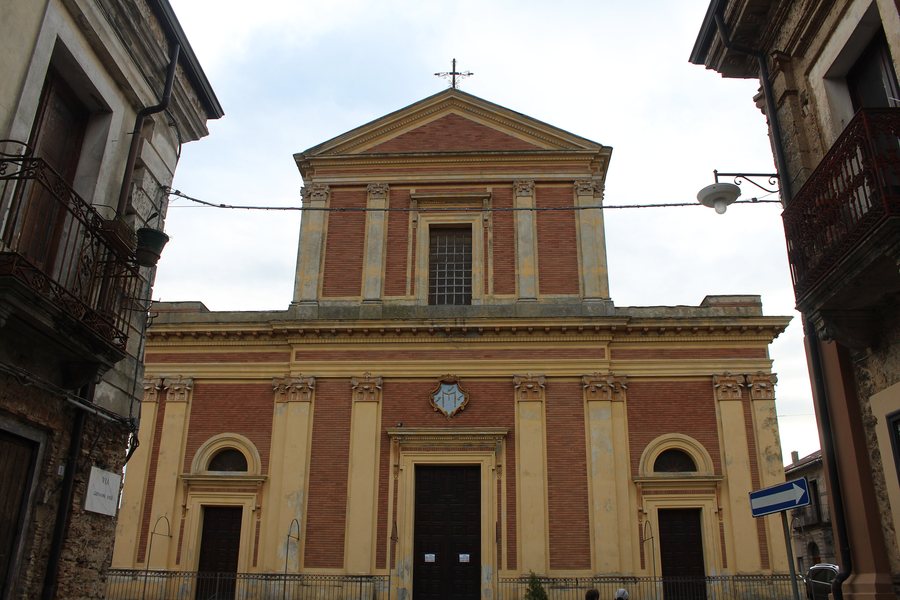
Several churches preserve noteworthy individual pieces. The bell tower of the Chiesa di San Teodoro houses the Campana della Misericordia, cast in 1590. The Chiesa di San Francesco di Paola preserves a bell from Santa Maria del Corazzo dating from 1613. The Chiesa di Santa Barbara contains a wooden crucifix whose depiction shows Christ still alive.
Smaller architectural details also deserve attention. A portal of an old palace in the Santa Barbara district bears a dual emblem featuring a phoenix and an eagle. The transept of the Chiesa del Carmine contains a statue by the same artist as one preserved in Messina.
Customs, Festivals and Local Forms of Expression
Filadelfia’s cultural heritage includes poems in the local dialect. The “cumprunta” is a religious rite in Filadelfia. The so-called “Ballo del Cammello” is part of the San Francesco di Paola festival and is performed to the rhythm of large drums on the first Sunday in August. The “Carnivaletto” takes place after the official carnival celebrations have ended.
More recent events also address local themes. The Estemporanea d'Arte Giovani di Filadelfia is a painting competition for participants aged 9 to 18. In its fourth edition, the town’s four historic church squares were the subject of the competition. In culinary terms, the third edition of the Sagra delle Zeppole, held in 2026, showcased traditionally prepared zeppole as well as Ngargadhàti with salted anchovies.
Castelmonardo in the Wider Regional Area
Castelmonardo lies on a hill southeast of Filadelfia. The ruins of the former town are spread across three nearby hills. The Istituzione Comunale Castelmonardo promotes awareness and communication of the archaeological and historical remains; it also enables organized group visits to the Castelmonardo archaeological site. When planning your trip, you can therefore distinguish between the cultural sites in Filadelfia and this historic destination in the wider regional area. When choosing accommodation in Filadelfia, this allows you to decide which focus you would like to give your trip.
Other destinations: Torre Marino, Ricadi, Vibo Valentia, Acquaro, Brattiro', San Costantino Calabro, Mongiana, Sant'onofrio
To the overarching travel overview: Vibo Valentia.

.jpg)