
Agerola: Hiking, Churches and Regional Specialties
Accommodation in Agerola
History Reflected in the Townscape
Agerola combines impressive hiking landscapes with a multifaceted cultural heritage. The first records of the Chiesa di San Matteo Apostolo date back to 1158. After the church had been destroyed, it was rebuilt in 1580 in the square of Bomerano, where it still stands today. With its elegant façade, it is an important historical and architectural landmark on the central square of the district.
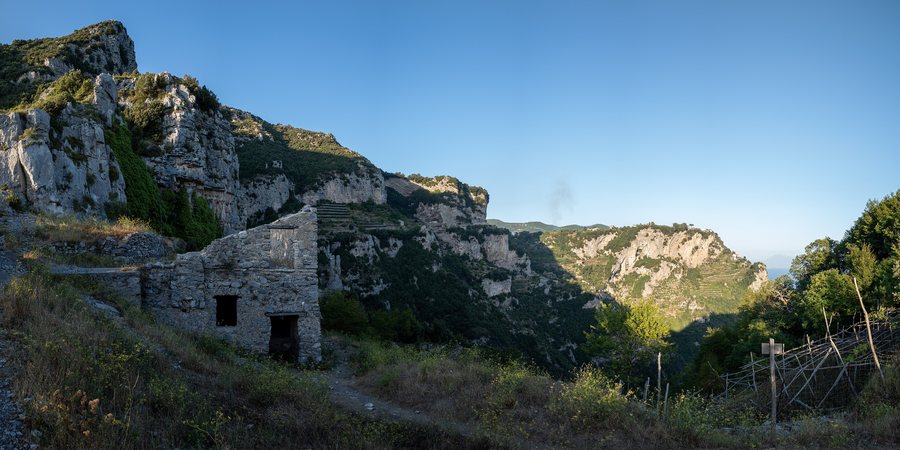 File:House ruins nearby the Path of the Gods Trail, Agerola, Italy (PPL3-Altered) julesvernex2.jpg
Photo: Jules Verne Times Two via Source, CC BY-SA 4.0
File:House ruins nearby the Path of the Gods Trail, Agerola, Italy (PPL3-Altered) julesvernex2.jpg
Photo: Jules Verne Times Two via Source, CC BY-SA 4.0
Other churches also tell of the town’s long history. The Chiesa Madonna delle Grazie was built on an older chapel that was mentioned in 1798. The Chiesa di Santa Maria La Manna was built in the 13th century. The adjoining oratory of the Chiesa di San Pietro Apostolo contains a painting of the Madonna del Carmine between Saint Anthony and Saint John, dated 1592. The Palazzo Acampora dates from the 18th century and is one of the rare examples of patrician residential architecture on the upper Amalfi Coast. Punta Miramare is also known as Punta di San Lazzaro and is associated with the creation of Salvatore Di Giacomo’s poem “Luna d’Agerola”.
Hiking Trails with Different Impressions
Agerola offers several clearly distinct hiking experiences for active days. The Sentiero degli Dei offers views of Positano, the Sorrento Peninsula, the Li Galli islets and Capri. The trail crosses the Vallone Gradelle and then reaches the hamlet of Nocella. The Circuito della Colonia Montana is a hiking trail without technical difficulties and begins in San Lazzaro, a district of Agerola.
The trail to the Convento di Cospiti is more demanding, with a medium level of difficulty. It leads to views of Amalfi and the remains of a medieval monastery. The Circuito Tre Calli circular route leads to Monte Tre Calli, where a 360-degree view opens up over the Gulf of Salerno, the Sorrento Peninsula and Capri. The Circuito Colle Sughero runs via Crocelle, Colle Sughero and Colle Sant'Angelo, where there is a view of the Gulf of Naples.
Nature and Peaceful Breaks
The Anello del Penise runs along the Penise River through a green valley with chestnut forests and passes rock dwellings as well as the ruins of an old Bourbon gunpowder magazine. The Valle delle Ferriere route begins in the village of Caneglio; from there, a mule track leads towards Monte Murillo. The Valle delle Ferriere also includes an integral nature reserve with rare and endemic plant and animal species.
For a more relaxing break, Parco Corona offers a playground, a picnic area and a path lined with chestnut trees. Parco Colonia Montana is a three-hectare green terrace above the coast, with views of Agerola and Monte Tre Pizzi.
Regional Cuisine and Festivals
The local cuisine can be discovered through characteristic cheeses and products. Provolone del Monaco D.O.P. is made from the milk of Agerolese cows. Fiordilatte is a fresh pasta filata cheese with a long tradition. The festival-associated route “Il Borgo del Pane” includes guided visits to local dairy and bread producers, tastings and ethnocultural activities.
The Agerola World Music Festival was held as a cultural event on the third weekend of July in the Bomerano district. FiordilatteFiordifesta was held in the first week of August as a festival celebrating fiordilatte and typical products from Agerola.
Discover More Destinations
Monte Di Procida, Naples, Calvizzano, Cercola, Pimonte, Marano Di Napoli, Capri, Lido Di Licola
To the overview of higher-level destinations: Naples.

_julesvernex2.jpg)