
Discover Marigliano: Military History, Monastery and Art
Accommodation in Marigliano
Marigliano offers a glimpse of different aspects of its history: an early fortress, the Torre Civica e Campanile, later converted into a bell tower, and the San Vito Monastery, as well as the artworks in the Collegiata. These topics offer different ways to explore the town: military function, religious history and visual art. If you are considering a historically rich destination for your trip to Italy, you can assess Marigliano according to which of these perspectives interests you most.
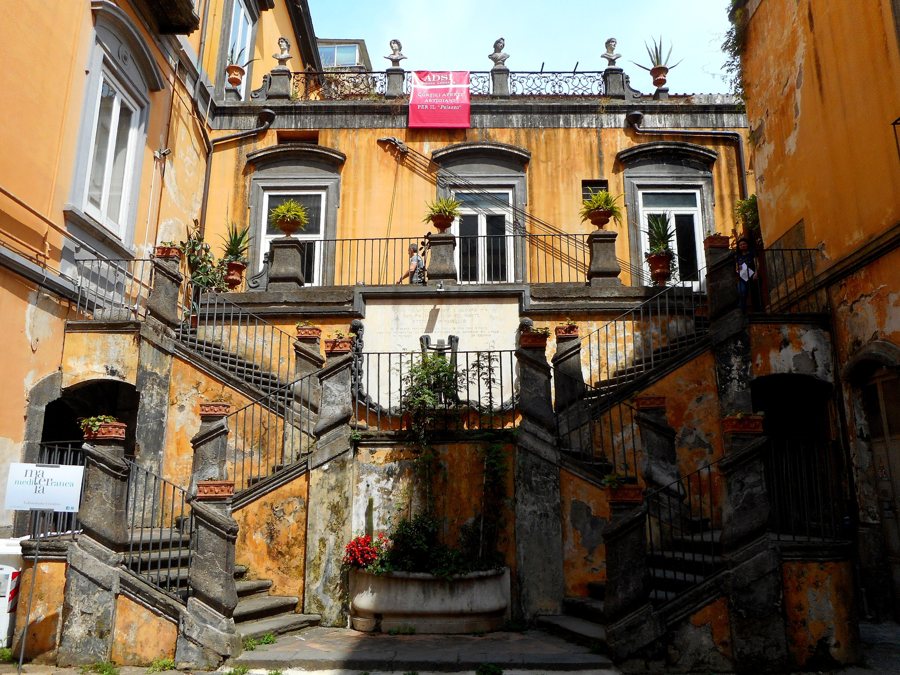 File:Great staircase (18th century) of Marigliano palace in Naples (27586002997).jpg
Photo: Carlo Raso from Naples, Italy via Source, public_domain
Early History and Fortress
Marigliano’s history dates back to the Roman era. By 1134, surviving sources already mention a fortress, regarded as the town’s first and then belonging to Roberto di Medania, Count of Acerra. Two different time scales therefore sit side by side: origins reaching far back in time and a specific medieval milestone with a named owner. The fortress offers a glimpse into Marigliano’s military and political history. Its status as the first fortress and its ownership at the time give this period of the town’s history a distinct focus.
From Defensive Tower to Bell Tower
The Torre Civica e Campanile followed a different course. Originally, it stood along the route of the medieval town wall and served for observation and defense. From the 16th century onward, it was converted into a bell tower. This change shows how the function of the same building evolved over time: its role in observation and defense was followed by use as a bell tower. To understand it, then, the sequence of its original purpose and later transformation matters as much as its name. Both the fortress and the tower point to military history, but with different emphases: the fortress’s early status and ownership come to the fore, while the tower illustrates a change of function.
The History of the San Vito Monastery
The San Vito Monastery offers another historical perspective. It was built in 1497 beside the old Church of San Vito by Alberico Carafa, the first Count of Marigliano. Two years later, in 1499, Carafa donated it to the Frati Minori Osservanti. This sequence distinguishes the monastery’s construction from its later donation to the order. Its location beside the old church is also part of its history: the monastery and church are connected as neighboring sites. The year it was built, its founder and the donation give the monastery’s development a specific timeframe and a distinct religious context.
The Elijah Paintings in the Collegiata
The paintings in the Collegiata shift the focus from construction and ownership to religious imagery. Two paintings depicting miracles of the prophet Elijah are located on the choir’s side walls. On the right is the descent of fire from heaven in response to his prayer; on the left, the rain Elijah announced to King Ahab. Both scenes relate to the same prophet but depict different events. Knowing which side wall each is on helps distinguish the scenes. Those interested in religious art can consider both Elijah himself and the differences between the two subjects.
Historical Highlights for Planning Your Trip
The military history of the fortress and tower can be understood differently from the monastery’s history and the religious imagery of the Collegiata. The former focus on buildings, function and change; the latter on the founding of a monastery and depictions of biblical events. If you are considering Marigliano as a place to stay, this distinction can help you assess the town in light of your cultural interests. When looking for a hotel in Marigliano, asking whether you are more interested in military or religious history gives you a concrete, personal starting point.
Discover More Destinations
Discover more destinations: Sant'Anastasia, Schiazzano, Lido Di Licola, Boscoreale, Sant'Antimo, Castellammare Di Stabia, Pollena Trocchia, Ottaviano.
Back to the main travel overview: Naples.

