
Galeata: Archaeology, Architecture and Paths Through History
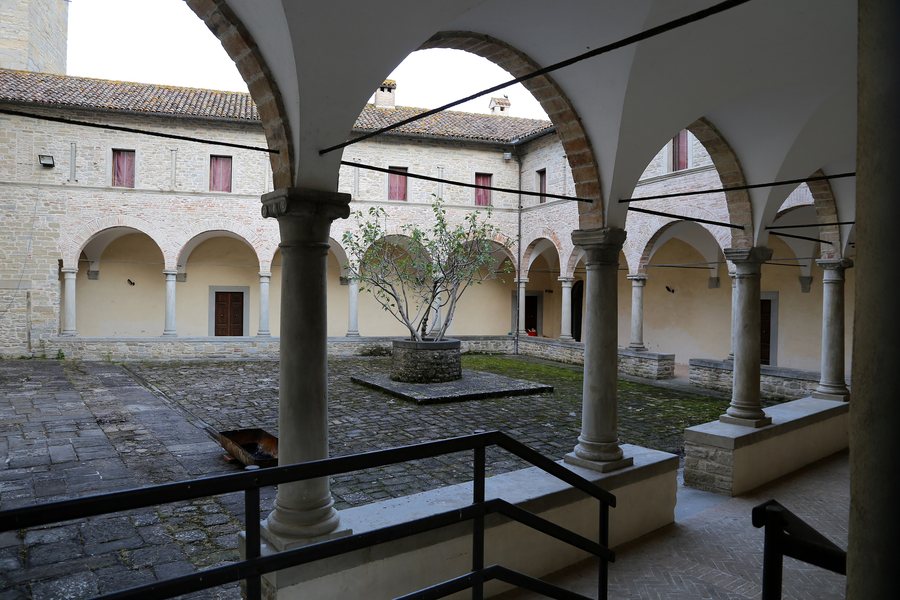 File:Pianetto (galeata), santa maria dei miracoli, esterno, chiostro 01.jpg
Photo: Sailko via Wikimedia Commons, CC BY-SA 4.0
File:Pianetto (galeata), santa maria dei miracoli, esterno, chiostro 01.jpg
Photo: Sailko via Wikimedia Commons, CC BY-SA 4.0
Galeata combines the archaeological excavations of Mevaniola and Villa Teodorico with the Museo civico “Mons. Domenico Mambrini,” the Church of Santa Maria dei Miracoli in Pianetto, the Palazzo del Podestà and the Sentiero delle Cellette. Archaeology, sacred buildings, remains of fortifications and historic paths stand alongside one another as different themes. In Galeata, those interested in culture encounter archaeology, architecture and the history of paths at several specific sites.
Archaeological traces from different periods in Mevaniola and at Villa Teodorico
At the archaeological excavations in Mevaniola, a thermal complex with a heated room, pools and a large unheated room, probably used as a frigidarium, was discovered. In the archaeological area of Villa Teodorico, the remains of a large villa from the period of Theoderic’s rule in Italy in the 5th or 6th century AD can be seen. The two archaeological sites therefore have different focuses: in Mevaniola, a thermal complex is the central feature, while at Villa Teodorico, the remains of a large villa take center stage.
Museum and sacred buildings in Pianetto and at S. Ellero
The Museo civico “Mons. Domenico Mambrini” is housed in the Convento dei Padri Minori di Pianetto. The museum’s collection is divided into a historical-artistic section and an archaeological section. Pianetto is home to the museum in the Convento dei Padri Minori di Pianetto and the Church of Santa Maria dei Miracoli. The Church of Santa Maria dei Miracoli in Pianetto was built in 1497. The abbey church of S. Ellero contains a sarcophagus with the mortal remains of the saint. A Romanesque façade made of sandstone blocks dates from the 11th or 12th century.
Town tower, gates, keep and dimensions at the Palazzo del Podestà
The Palazzo del Podestà in Galeata features a town tower and a Florentine Marzocco. A Marzocco is a Florentine lion emblem. Visible today are a wall more than 300 meters long with projecting defensive elements, two gates and a square keep measuring approximately 5 meters on each side and around 10 meters in height.
Paths and special events in Galeata
The Sentiero delle Cellette features fourteen sandstone Stations of the Cross; the walking time is 40 minutes. The Via Romea Germanica is now the official route of Abbot Alberto’s travel itinerary. The event “Galeata Cavalli – Mostra del Cavallo e del Puledro” includes equestrian performances as well as “Battesimo della sella.” Equestrian performances and “Battesimo della sella” also add an event format centered on horses and riding. With the stated walking time of 40 minutes, the Sentiero delle Cellette can be planned as a separate section between the other cultural sites.
More local pages: Longiano, Villamarina, Tredozio, Rocca San Casciano, San Vittore, Fratta Terme, San Mauro A Mare, Montecchio.
To the higher-level travel overview: Forlì-Cesena.
Check prices, availability and amenities for your travel dates directly on Booking.com.
View accommodations and offersAdvertisement · Affiliate link to Booking.com
,_santa_maria_dei_miracoli,_esterno,_chiostro_01.jpg)