
Discover Canossa: Castles, Nature and Trails
Accommodation in Canossa
Canossa combines history, geology and a variety of trails. At Castello di Canossa, the historic encounter took place in 1077 during the Investiture Controversy, when Emperor Henry IV humbled himself before Pope Gregory VII so that his excommunication would be lifted. This setting gives a trip to Canossa a clear focus on cultural history, while the protected landscape opens up further ways to explore the surrounding area.
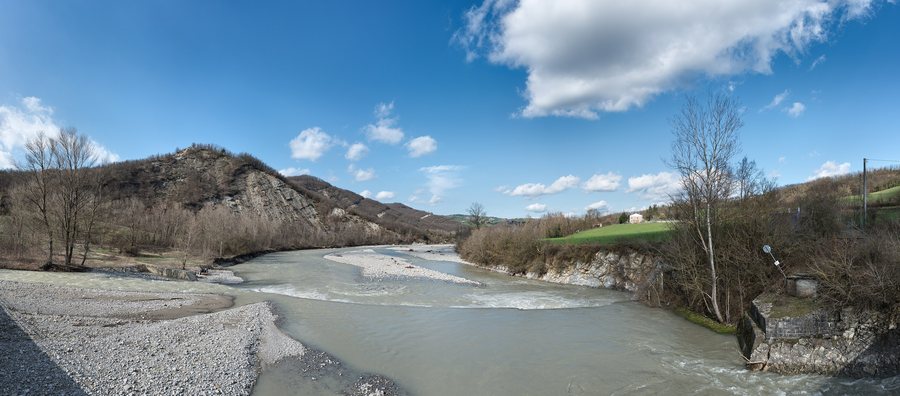 File:Torrente Enza - Canossa, Reggio Emilia, Italy - March 27, 2015 02.jpg
Photo: Giorgio Galeotti via Wikimedia Commons, CC BY 4.0
File:Torrente Enza - Canossa, Reggio Emilia, Italy - March 27, 2015 02.jpg
Photo: Giorgio Galeotti via Wikimedia Commons, CC BY 4.0
Castles and cultural history
Castello di Rossena rises on a steep ophiolite rock face. Some frescoed walls have been preserved there, adding to the building’s medieval character. The Torre di Rossenella is also closely linked to Canossa’s cultural history. It dates from the 12th century and is located within the Riserva Naturale Rupe di Campotrera. The Casa del Tibet di Votigno provides another distinctive feature: the international cultural centre was founded in March 1990 under the patronage of the Dalai Lama in a medieval village in Canossa.
Geology in the Riserva Naturale Rupe di Campotrera
The Riserva Naturale Rupe di Campotrera covers 42 hectares in Canossa. It is included in the SIC area “Rupe di Campotrera-Rossena” and in the protected natural landscape of Colline Reggiane-Terre di Matilde. Rare datolite crystal formations and pillow lavas occur in the Rupe di Campotrera. These pillow lavas formed through the rapid cooling of lava in seawater. The reserve is therefore of particular geological and botanical interest.
Trails for short and longer tours
For a manageable hike, the Sentiero geologico del Rio della Fornace is a good choice. The trail is easy to walk and signposted; along the way, you can discover geological and ecological features of the protected area. Torre di Rossenella can be reached on foot from the lower car park in about five minutes, making the historic tower a practical destination for a shorter exploration.
Those who would like to include longer routes in their travel plans will find a much greater scale in the Sentiero dei Ducati. The trail is 201 km long and runs from Reggio Emilia to the Ligurian Sea. Its second stage passes through the heart of the Reggio hills and the Matildic castles. These include Castello di Bianello and Castello di Canossa; the stage also runs through quiet valleys and medieval villages and ends in Votigno di Canossa. This allows you to choose between a geological trail in the protected area and an extended section through hilly landscapes.
Regional flavours from Reggio Emilia
The cultural diversity also includes the Acetaia comunale Rupe di Canossa. It offers guided historical and sensory tours focusing on traditional balsamic vinegar from Reggio Emilia PGI. When choosing your accommodation, you can therefore define your personal focus clearly: castles and history, geological features, a short walk or a longer trail section can take centre stage.
More destinations
For further travel planning: Cadelbosco Di Sopra, Ramiseto, San Donnino Di Liguria, Campegine, Vecchia, Cerredolo, San Giovanni, Villa Minozzo
For the overarching travel overview: Reggio Emilia.

