
Montebello: Protected Area, Castello and Beekeeping Culture
Accommodation in Montebello
Montebello between Protected Area and Local History
Montebello can be explored through three interconnected themes: a protected hilly landscape, a distinctive architectural history and the culture of beekeeping. This creates a place where nature, historic architecture and regional agriculture come together through different thematic approaches. The following destinations and routes should each be considered in terms of their own character: the protected area represents the landscape, the Castello represents local history and the Museo del Miele represents beekeeping culture.
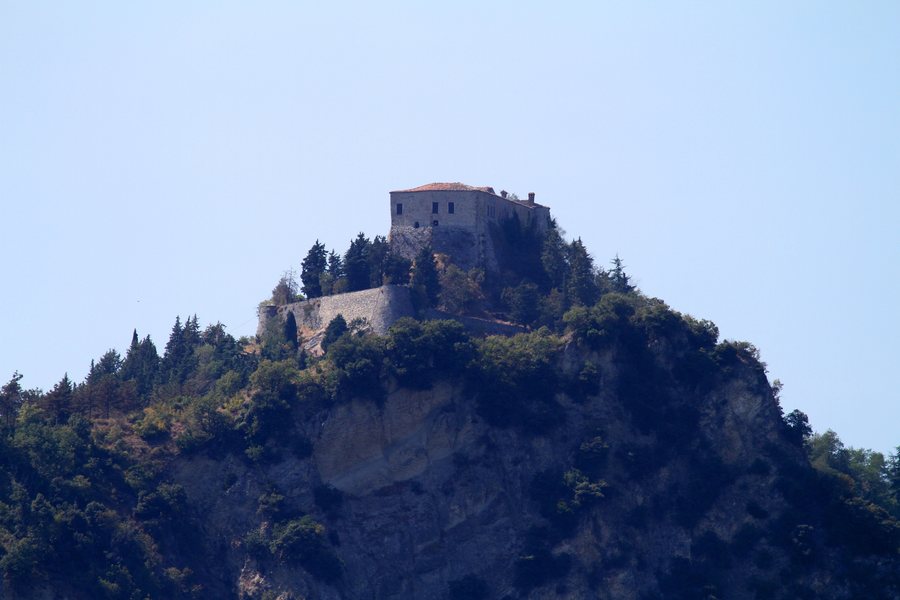 File:Castello di Montebello - panoramio.jpg
Photo: Carlo Pelagalli via Wikimedia Commons, CC BY-SA 3.0
File:Castello di Montebello - panoramio.jpg
Photo: Carlo Pelagalli via Wikimedia Commons, CC BY-SA 3.0
Hills, Rock Faces and Geological Heritage
The protected area IT4090002 encompasses the hills and rock faces from Montebello to the Uso and its tributary, the Rio Morsano. Montebello belongs to this protected area, which is designated as an SAC-SPA.
In the “Dalla collina al mare” project, the geological heritage is considered particularly valuable from a scientific, landscape and educational perspective. It offers an exploratory route to the Rupi di Torriana e Montebello. For those interested in landforms and geological history, this provides a distinct way to experience Montebello without limiting the area to its historic architecture.
Route Information for Orientation
The “Ponte Verucchio, Montebello, Torriana” hiking trail follows an unpaved path towards Montebello and passes Fontebuona, where mains water is available. For orientation purposes, both the path surface and Fontebuona as a specific point are therefore relevant. If you include this route in your plans, take the unpaved section and the water point at Fontebuona into account.
Castello di Montebello and Historic Architectural Forms
The Castello di Montebello was built around the year 1000 on the foundations of a Roman tower dating from the 3rd century BC. The building combines a Renaissance wing with a wing in the form of a military fortress. This overlap of different construction phases makes the Castello interesting if you would like to trace historical development through a specific building.
The surroundings of Montebello also broaden the cultural context. Palazzo del Poggiano is a palace in the vicinity of Montebello; the Governmant Museum is a museum there.
Honey, Agriculture and Beekeeping Culture
The Museo del Miele di Montebello collects local documentation, eyewitness accounts, traditions and regional characteristics related to beekeeping. It provides knowledge about honey, its uses and production, as well as about the connection between honey, the area and agriculture.
Together with local associations, the Museo del Miele di Montebello organizes themed hands-on activities for the public. It also offers educational projects to teach beekeeping culture to schools from the surrounding area and beyond. One format is aimed at the public, while the other is aimed at schools—this distinction helps you classify the cultural offerings according to the purpose of your trip.
When choosing a hotel in Montebello, you can therefore first determine the focus you want for your trip. The Castello appeals to those interested in architectural history, the Museo del Miele to those interested in beekeeping culture, while the protected area and hiking trail highlight the connection with the landscape. This distinction can serve as thematic guidance when selecting a hotel in Montebello.
Other places for planning your trip: Monte Colombo, Cerasolo, Morciano di Romagna, Torriana, Rimini, Casteldelci, Poggio Berni, San Clemente
To the higher-level travel overview: Rimini.

