
Discover Torriana: Borgo, Fortresses and Nature
Accommodation in Torriana
Torriana between the Borgo and Valley Views
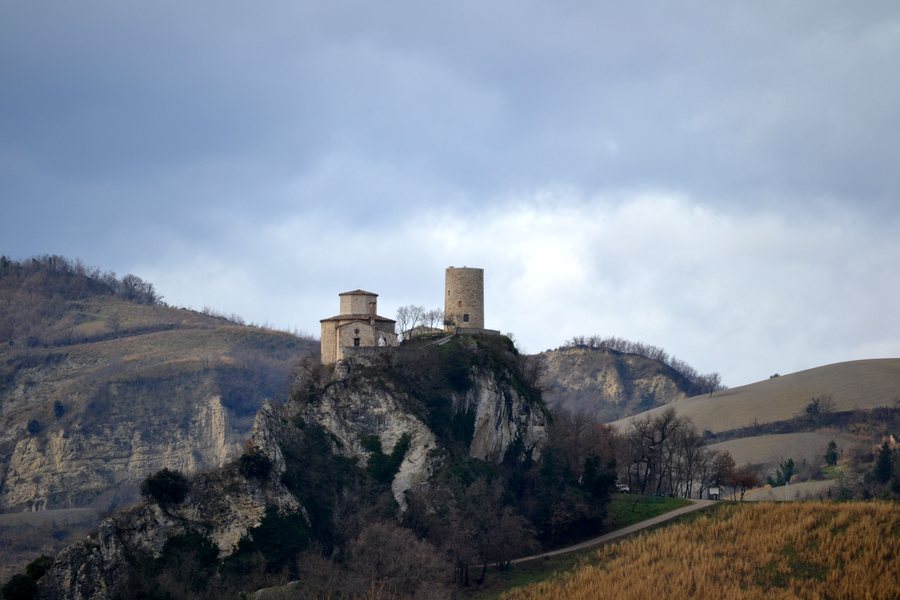
Torriana combines an old medieval borgo with striking fortresses, expansive valley views and a protected natural area. The Borgo di Scorticata dominates the Marecchia Valley and is known as the “Balcony of Romagna” because of its elevated view over the valley. This creates a townscape in which history and landscape stand closely together, without reducing Torriana to a single experience.
 File:Poggio Torriana - Santuario della Madonna di Saiano - 2025-09-23 09-59-10 001.JPG
Photo: Maddy16869 via Wikimedia Commons, CC BY-SA 4.0
File:Poggio Torriana - Santuario della Madonna di Saiano - 2025-09-23 09-59-10 001.JPG
Photo: Maddy16869 via Wikimedia Commons, CC BY-SA 4.0
The restored medieval Borgo di Scorticata contains a small church dedicated to Saints Filippo and Giacomo. The keep, an entrance flanked by two imposing round towers with an arch above it, and a cistern remain from the Rocca di Torriana.
Fortresses and Historical Connections
The Rocca di Torriana was a medieval fortress built to guard the ancient Via Maior. This route led up the Valmarecchia and formed an important connection to Montefeltro and Tuscany. Those interested in the history of ancient routes and fortified places will therefore find not only individual walls here, but also a regional context linking the valley, elevated locations and long-distance connections.
Castello di Montebello also represents a complex building history. It was built around the year 1000 on the foundations of a Roman tower from the 3rd century BC and stands at an altitude of 436 metres. From there, Castello di Montebello overlooks the lower Marecchia Valley and the Uso Valley. The daytime tour includes all the rooms of the manor house and displays furnishings dating from the 14th to the 19th century.
Natural Area between Torriana and Montebello
The Natura 2000 site IT4090002 includes the hills and rocks of Torriana and Montebello. This area contains 22 habitats of Community interest, including seven priority habitats. Alongside its historic buildings, the landscape therefore has an independent natural-history dimension, making it particularly suitable for travellers who wish to combine culture and landscape during their trip to Italy.
The second section of the Oasi Montebello Nature Observatory focuses on the geological and geomorphological features of the valley and on the relationship between people and their living environment. The perspective thus extends from the forms of the terrain to the question of how people live in this landscape. You can therefore view Torriana and Montebello both through their history and through their natural foundations.
Out and About, Craftsmanship and Local Traditions
Between Torriana and Montebello, there is a well-maintained and well-signposted network of paths for hikers, mountain bikers and horse riders. Depending on your preference, you can explore the landscape on foot, by mountain bike or on horseback.
At the Museo Vivente della Tessitura, Torriana offers beginner courses and educational activities in cooperation with schools in the region. The museum thus combines the practical side of weaving with the teaching of regional knowledge. On other days, an appointment is required to visit the workshop of the Museo Vivente della Tessitura. Torriana’s local profile is complemented by its connection with a historic and highly regarded honey production tradition.
Further destinations for planning your trip: Montescudo, Case Di Pedrolara, Morciano di Romagna, San Giovanni In Marignano, Coriano, Verucchio, Pennabilli, Casteldelci.
To the main travel overview: Rimini.

