
Aviano: Cycling Routes, Piancavallo and Historic Architecture
Accommodation in Aviano
Aviano can be explored in a variety of ways: along distinctive cycling connections, through historic buildings and with views of the mountain landscape of Piancavallo.
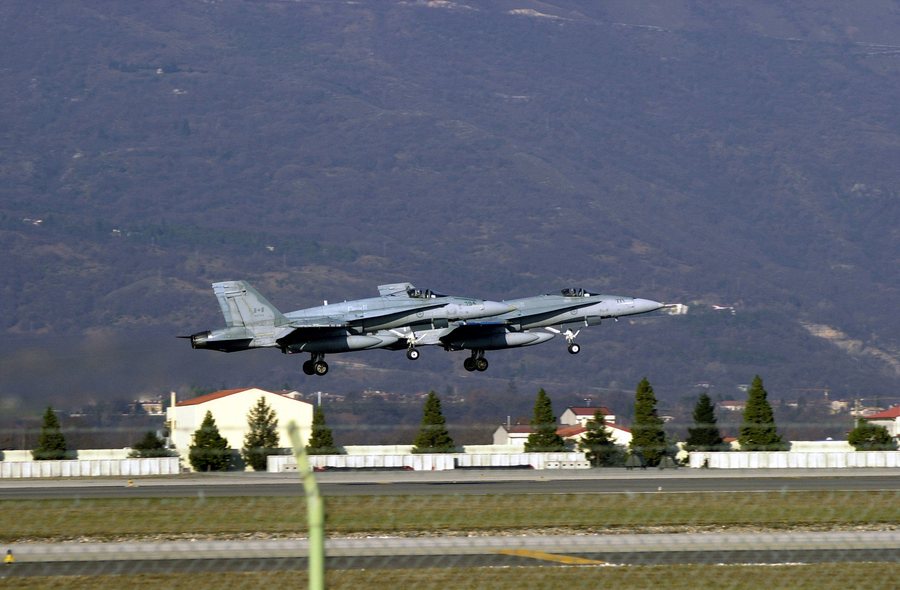 File:CF-18 Aviano Italy.jpg
Photo: Service Depicted: Multi-National Command Shown: USAFE Camera Operator: SSGT JENNIFER C. WALLIS, USAF via Source, Public domain
File:CF-18 Aviano Italy.jpg
Photo: Service Depicted: Multi-National Command Shown: USAFE Camera Operator: SSGT JENNIFER C. WALLIS, USAF via Source, Public domain
Cycling Connections and Piancavallo
The route from Aviano to Budoia runs almost entirely along the Ciclovia FVG 3, the Ciclovia Pedemontana e del Collio. Another notable connection is the Salita del Giro d’Italia Aviano–Piancavallo cycle route (P002). It follows Marco Pantani’s iconic climb in the 1998 Giro d’Italia, starts on the outskirts of Aviano and leads to Piancavallo.
Piancavallo has trails for trekking and mountain biking. On sunny days, the view from the highest peaks extends as far as the Adriatic Sea; all around, the surroundings are shaped by a typical Dolomite landscape. Piancavallo is also served by public bus routes. These public bus routes are likewise part of planning your journey for a stay in Piancavallo.
Historical Traces in and Around Aviano
Near Cente di Marsure, the San Lorenzo fortification is still clearly visible. It consists of a double circular wall made of roughly hewn, irregularly horizontally layered stones. The clearly recognisable wall structure in particular makes the site an illustrative historic building.
The Castello d'Aviano dates from the first half of the 10th century. Despite centuries of attacks, destruction and rebuilding, it still reveals the original structure of an imposing fortification. In 967, Emperor Otto I of Saxony handed Castello di Aviano over to the Patriarch of Aquileia.
The church of San Gregorio in Castello d’Aviano contains frescoes from a cycle in which Gianfrancesco’s style is particularly pronounced. The frescoes are dated to 1496 and add an art-historical dimension to the town’s medieval architectural history.
Villas, Churches and Industrial Archaeology
Villa Policreti also brings together different historical periods. The oldest central section dates from 1565. The villa’s park includes a romantic 19th-century park with an extensive meadow, the Grotto of Venus, a green clearing and a pond. Villa Policreti combines a central section dating from 1565 with a romantic 19th-century park.
The Pieve di S. Giuliana in Aviano contains frescoes from the 14th and 15th centuries. A larger Pieve di San Zenone was built on the same site to a design by Francesco Riccati. Near the entrance are stone holy-water stoups from the 16th century.
The former Giais hydroelectric power station in Aviano was built around the turn of the 20th century and is an important example of industrial archaeology. The visible history therefore ranges from sacred art and fortifications to the technical past.
View More Locality Pages
For further travel planning, you can also view these locality pages: Cordenons, Pordenone, Rauscedo, Pasiano di Pordenone, San Quirino and Polcenigo.
Back to the higher-level travel overview: Pordenone.

