
Muggia Between Coast and History
Accommodation in Muggia
Muggia Between Coast and History
Muggia is framed by seven kilometres of coastline and a chain of hills offering panoramic views across a vast area of Italy and Istria. The Castelliere di Elleri lies at more than 240 metres above sea level and overlooks the Bay of Muggia and the Gulf of Trieste to the south. This gives the area two distinctive landscape settings: the waterfront and the higher-lying areas. This combination gives Muggia a clear profile for days when landscape and history are equally important.
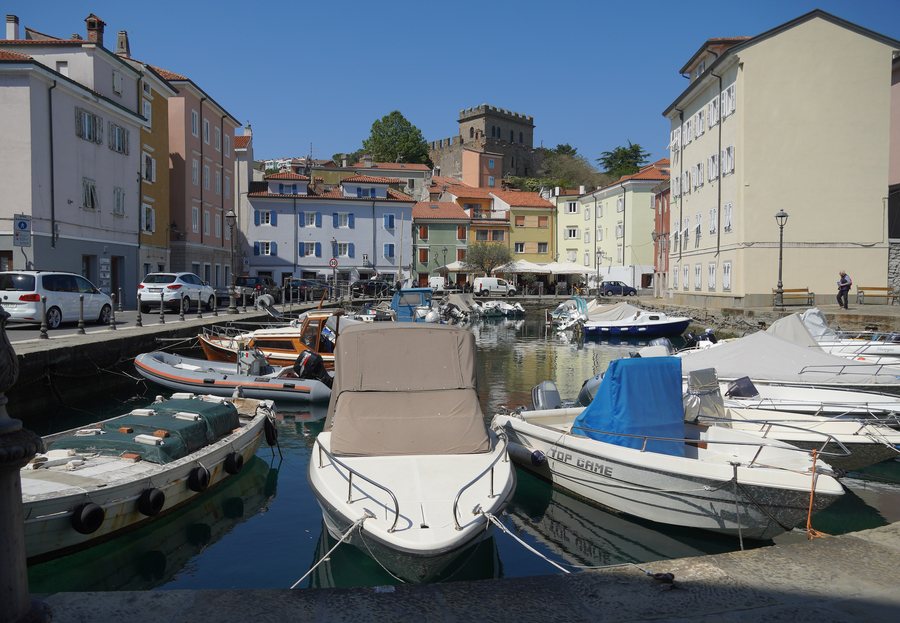 File:Muggia, view from the harbour to the Castello of Muggia (Italy).jpg
Photo: Naturpuur via Wikimedia Commons, CC BY-SA 4.0
File:Muggia, view from the harbour to the Castello of Muggia (Italy).jpg
Photo: Naturpuur via Wikimedia Commons, CC BY-SA 4.0
Paths along the coast and through the municipality
Two different routes are the focus for walks and longer stretches of hiking. The Traversata Muggesana is a historical and nature trail that crosses the entire municipality of Muggia. The Costiera muggesana is a coastal walking route running from Muggia’s historic centre to the border at San Bartolomeo and is just over 6 kilometres long. The routes therefore differ above all in their geographical scope: the Traversata covers the municipality as a whole, while the Costiera follows the coast. If you plan your days around your landscape interests, you can choose between a comprehensive crossing and a clearly defined coastal route.
Archaeological traces and medieval buildings
The historical sites span a broad period of time. The Castelliere di Elleri was built in prehistoric times, around 1600 BC, and was inhabited for 2,000 years until the Roman period. In Muggia Vecchia, the Romanesque basilica dates from the 9th century. In the Archaeological Park of Muggia Vecchia, visitors can trace the history of the fortified medieval settlement along several visitor routes and with the help of numerous information panels. The Church of Santi Giovanni e Paolo in Muggia was consecrated on 29 December 1263. The historical sequence therefore extends from prehistoric times through the Roman period to the Middle Ages.
Art and museums in Muggia
The Collezione Ugo Carà, housed in Muggia, comprises more than 100 works by the sculptor, painter, graphic artist and designer Ugo Carà (Muggia 1908–Trieste 2004). Sculpture, painting, graphic art and design illustrate the breadth of his artistic work. The Museo di Muggia e del Territorio is a museum in the immediate vicinity of Muggia. A stay here can therefore be combined with art in Muggia and another museum destination nearby.
Rio Ospo and Laghetti delle Noghere
Nature can also be seen as a distinct part of the local landscape. The Rio Ospo runs alongside the Laghetti delle Noghere biotope and supports the development of characteristic native flora and fauna there.
Carnevale di Muggia
A recurring cultural feature is the Carnevale di Muggia, also known as “Carneval de Muja”. It is an annual spectacle featuring allegorical floats and colourful masks. When choosing a hotel in Muggia, you can therefore focus on your personal priorities, whether coastal walks, historic sites, nature or culture.
More destinations for planning your trip
Other destinations include Nabrežina, San Dorligo Della Valle, Villaggio del Pescatore, Duino-Aurisina, Malchina, Grignano, Repen and Trieste.
For the higher-level travel overview: Trieste.

.jpg)