
Discover Zovello: Frescoes, Churches and Cjarsons
Accommodation in Zovello
Zovello reveals itself through tangible evidence from its architecture and ecclesiastical history, the old tradition of “fâ la Sensa”, Cjarsons and the “Zovello – Troi dal Pič” trail.
Architecture with stories of its own
The façade of Cjasa di Parigin features a large fresco from 1870 depicting the Lion of Saint Mark and a religious scene. Cjasa di Parigin is also a 17th-century building of considerable artistic and architectural value. Its age, façade design and pictorial subject come together here as particularly tangible evidence of the past.
Cjasa Chilin is an example of Carnic architecture from the 16th to the 17th century. Casa di Parigjin is one of the typical buildings in Zovello. The hamlet of Zovello in Ravascletto is also home to houses, hay barns, stavoli and churches that preserve treasures of immeasurable value. The different types of buildings give the local architecture a broad historical and structural character.
Sant’Andrea and ecclesiastical art
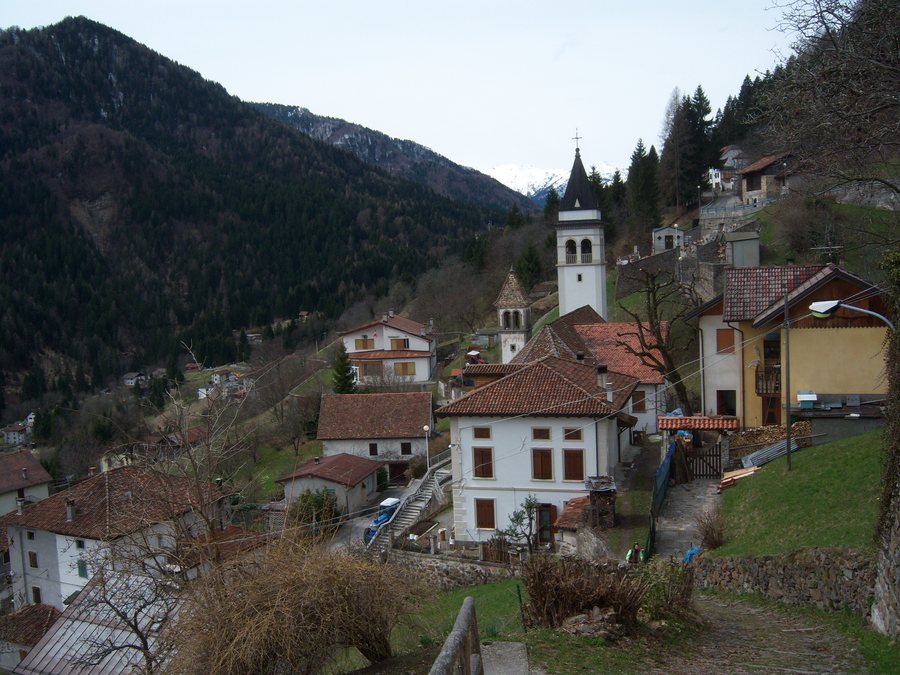
The church of Sant’Andrea in Zovello was first mentioned in 1320; its new bell tower was built in 1926. The church interior contains mainly 18th-century works, including altars, sculptures, paintings and chalices. Many of these works come from the German cultural sphere and were donated by the Cramârs. In this way, the church interior combines architectural history with a diverse collection of furnishings and artworks.
The bell tower of the church of Sant’Andrea in Ravascletto is a free-standing tower with a square floor plan. Its base consists of unplastered exposed stone, while the plastered shaft features loopholes and a clock face with Roman numerals. The square belfry has paired round-arched openings. Its materials, basic form and details define its architectural appearance.
Shrines, ruins and traditional customs
Maina dal Pič is a 19th-century votive shrine dedicated to the Madonna del Rosario, Our Lady of the Rosary. Castello di Fratta is an abandoned 17th-century dwelling situated in a place where the remains of an ancient fortress were found. Both sites combine tangible architectural evidence with religious memory and traces of an older fortress.
The old tradition of “fâ la Sensa” is celebrated on June 5 in Stalivieri di Zovello. It includes children’s games in the forest, the preparation of “Sopes e fritules”, the telling of legends from the Valcalda Valley and traditional music. Children, food, stories and music together form the handed-down content of this custom.
Hiking and local cuisine
The “Zovello – Troi dal Pič” trail is a hiking route with a walking time of one hour and 210 metres of elevation gain. The trail complements the historical themes with an active way to explore Zovello.
The Cjarsons made by 921 Zovello resemble ravioli and have a rich filling. They contain no sugar; instead, they are lightly sweetened with jam, raisins and cocoa. The 921 Zovello business invites visitors to taste its Cjarsons and offers these products for online ordering.
For the higher-level travel overview: Ravascletto.

