
Roccantica: Trails, Churches and Festivals in Sabina
Accommodation in Roccantica
Roccantica Between Landscape and History
If you would like to place Roccantica in the context of an individual trip to Italy, it is worth looking at the combination of nature experiences, medieval character and regional festival culture. The town offers a variety of points of interest: trails lead to distinctive landscape features, while churches, defensive architecture, historical documents and craft-based culture make the history tangible. Culinary traditions are also part of Roccantica’s character. When choosing accommodation, you can compare these focuses with your own travel rhythm: nature trails, local history, festivals and regional cuisine each set different accents.
Revotano, Macchia and Mountain Views
Revotano is a karst sinkhole near the historic centre of Roccantica, accessible via a footpath through Mediterranean macchia. It is a collapse doline that formed when a cavity created by underground water erosion collapsed under its own weight. The sinkhole has a diameter of approximately 250 metres and is 130 metres deep. This makes both the geological formation and the unusual shape of the terrain visible at this landscape feature.
Monte Pizzuto lies within the municipality of Roccantica. From Fonte Regna, a trail continues to viewpoints overlooking the Sabina Valley. For those interested in hiking, there is also the Cammino del Capraro: the old circular route leads from Roccantica to the Rifugio Cognolo shelter and is connected with the trails used by transhumant shepherds.
Churches and Historical Traces
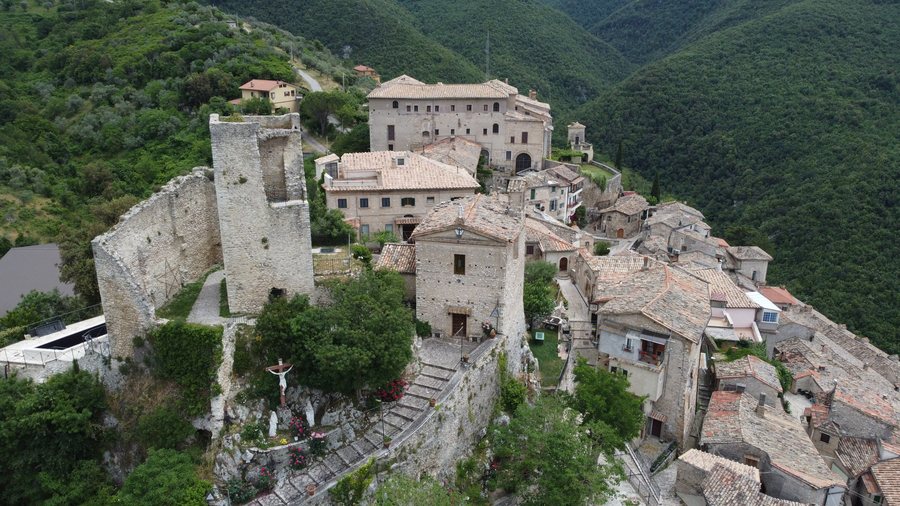
The hermitage of San Leonardo dates from the 8th or 9th century and consists of two rooms carved into the rock. Below the hermitage, on the way to Revotano, stands an old water mill, of which only the outer structure remains. In the historic centre of Roccantica stands a square defensive tower surrounded by three rings of walls.
The Church of Santa Maria Assunta is located in the heart of the historic centre. It has a single-nave layout and an apse with a semicircular end. The Church of Santa Maria Assunta in Cielo was built in 1740 over an earlier church. San Valentino is already mentioned in a document from 792; the Gothic church has five chapels.
The restored fresco cycle in the Church of Santa Caterina is one of the cultural highlights of the Tiberine Sabina. The frescoes depict the life of Saint Catherine of Alexandria and were created by Pietro Coleberti in 1430. The Archivio Storico di Roccantica preserves numerous documents from the Middle Ages. The Castle–Monastery of the Poor Clares complex was built in the mid-16th century over the ancient ruins of Ursino Castle.
Festivals, Costumes and Regional Cuisine
The events also give Roccantica a distinctive cultural profile. The historical reenactment Medioevo in Festa is held annually in mid-August. It includes a parade with more than 500 people in historical costumes. The Sartoria Medievale displays some of the more than 1,000 costumes made by the local medieval tailoring workshop on the basis of careful historical research.
A distinctive culinary tradition takes centre stage at the Frittello Festival. The event celebrates cauliflower fried in extra virgin olive oil from Sabina with DOP status. The tradition has existed for more than 50 years and takes place on Saint Joseph’s Day. The Vacunae Rosae garden adds a landscape highlight: the two-hectare themed garden contains more than 5,500 different roses.
More Destinations
Selci, Apoleggia, Varco Sabino, Torri In Sabina, Salisano, Antrodoco, Leonessa, Stimigliano
To the higher-level travel overview: Rieti.

