
Prima Porta: Villa of Livia and accommodation
Accommodation in Prima Porta
Prima Porta, in the area around Rome, is a destination for travelers who want to combine Roman archaeology with the town’s later history. The Villa of Livia is the main landmark: the statue of Augustus of Prima Porta was found there. Other points of interest include the Church of Saints Urban and Lawrence, a late Roman arch, and the Via Lauretana, a historic route. If you’re looking for a hotel, apartment, or holiday home for this part of your trip, first decide which of these topics actually interests you.
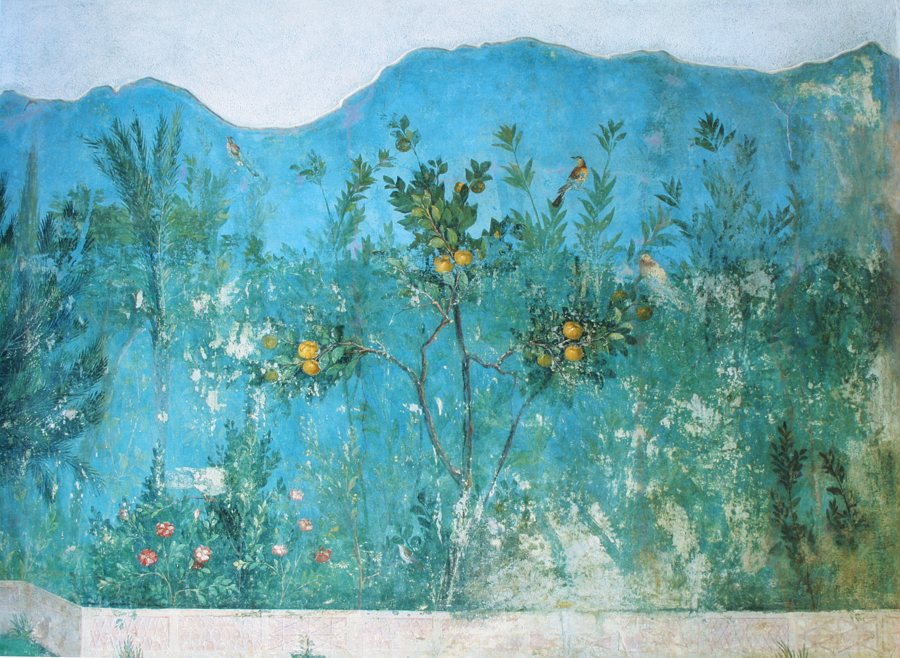 File:Scène de jardin, droite, Prima Porta, Italie.jpg
Photo: Unknown author Unknown author via Wikimedia Commons, public_domain
Villa of Livia and the discovery of Augustus
The archaeological site of the Villa of Livia is in Prima Porta, on the Via Flaminia, and is described as a complex set within nature. Private and reception rooms have been preserved: the bedrooms of Livia and the emperor, an atrium, a small courtyard garden, and a peristyle. The Antiquarium displays important finds recovered at the site. The famous statue of Augustus of Prima Porta was found in the ruins of this villa. This findspot explains the connection between the statue’s name and the place; it does not mean that the statue is currently on display there.
A lush painted garden once decorated the triclinium of Livia, Augustus’s wife, in her villa. Alongside the architecture and finds, this also draws attention to the design of the living spaces. If you would like to spend time at the villa, you can distinguish in advance between the surviving room types and the historical context. However, the finds and rooms mentioned do not establish current opening hours or full access to every area; these conditions should be checked separately before visiting.
Church, arch, and historic route
The original church of San Lorenzo in Prima Porta is mentioned as early as a document from 1109. The later Church of Saints Urban and Lawrence was rebuilt by Pope Urban VIII Barberini and elevated to parish church on March 7, 1629. The date describes its ecclesiastical status, not the age of every part of the building. A late Roman arch stands near the church; in the Middle Ages it was called “Prima Porta.” It probably belonged to an aqueduct serving the nearby Villa of Livia, so this attribution is a historical interpretation, not a confirmed identification.
At Prima Porta, the church marks the last urban section before the Via Lauretana continues through villages and landscapes in northern Lazio. This connection makes the town interesting for a trip along a historic route. However, it does not establish current transport links or a particular stage length. Choose your accommodation based on the section you actually plan to travel and current connections.
Another place with its own character
The Cimitero Flaminio, also known as the Cimitero di Prima Porta, was consecrated in 1941. It covers 140 hectares and is crossed by 37 kilometers of internal roads. An official description recognizes it as a work of contemporary cemetery architecture. This is a different subject from the Roman villa or the church’s earlier history; if you plan to visit, please do so respectfully and check current access conditions.
The page about Rome provides the broader regional context. In Prima Porta itself, the villa, church, arch, and cemetery offer different reasons to visit. Compare the accommodation address, travel dates, and options with the places you really want to see, rather than assuming from the name Prima Porta that a particular location is nearby or that a hotel has a certain standard.

