
Plesio among mountain paths, churches and local history
Accommodation in Plesio
Mountain paths and views
Plesio reveals its character through the combination of mountain paths, religious buildings and traces of everyday local life. The Anello del Munt circular trail begins near the Cappella del Bergum, after walking from Mulino Spinzi for about 40 minutes along a mountain road to the Piazza. The circular trail offers a view of Lago Ceresio. The lake thus gives the hike a clear scenic context.
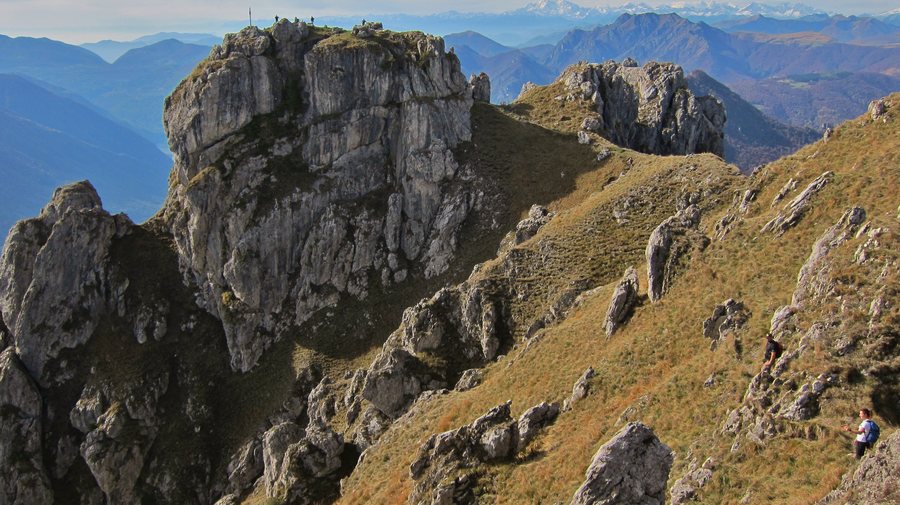 File:Cima del Monte Grona 1.736 m s.l.m, vista dal lato est della cresta 2015-10-25, Plesio (Como).JPG
Photo: Mænsard vokser via Source, CC BY-SA 4.0
File:Cima del Monte Grona 1.736 m s.l.m, vista dal lato est della cresta 2015-10-25, Plesio (Como).JPG
Photo: Mænsard vokser via Source, CC BY-SA 4.0
The Anello di San Domenico also starts in Breglia and leads to a viewpoint near the Cappella di San Domenico. From the Oratorio di Sant’Amate, you can take the path to Monte Bregagno. The hike from Breglia to Rifugio Menaggio initially follows a paved road, then continues along a forest path beside a gravel road closed to traffic. The different surfaces give your day’s planning a concrete rhythm.
Churches and religious heritage
The Santuario della Madonna di Breglia was built in the second half of the 18th century. A Stations of the Cross with depictions of the Mysteries of the Rosary leads to it. The sanctuary houses a Madonna made of marble. Her veneration can be traced back more than two centuries; in 1740, a man from the Tatti family brought her from Genoa to Breglia. The building, imagery and provenance come together here to offer a vivid approach to the history of Breglia.
The churches also tell of different historical periods. The Church of San Fedele was elevated to parish church status in 1582 and partially rebuilt between 1808 and 1836. The present building of the Church of San Gregorio Magno in Breglia dates from 1873; it replaced an older structure that had been destroyed by a major landslide. In Barna, the Church of Santa Maria Maddalena dates from the first half of the 17th century. For visitors interested in culture, this creates a succession of different building and local histories.
Everyday life, work and mountain landscapes
Among the more unusual architectural features is the most elaborate washhouse in Barna. It is located in a loggia covered by a groin vault and open on all four sides. Above the settlement of Ligomena lie the remains of the “Fiamma di Plesio” marble quarry. The quarry was operated for about two decades, from 1935 to 1955. The washhouse and quarry thus also draw attention to earlier forms of everyday life and work.
The local mountain landscape also includes Alp Nesdale, where summer transhumance continues to be practiced and cheese is produced. This refers to the seasonal movement of herds between different grazing areas. As a larger landscape context, the approximately 125-kilometre-long Via dei Monti Lariani can be considered. It consists mostly of paths and mule tracks, runs high above the entire western shore of Lago di Como and connects Cernobbio with Sorico. In Plesio, hiking trails, mountain farming, viewpoints and historical evidence thus exist side by side.
Discover more destinations
Appiano Gentile, Santa Maria Rezzonico, Lurate Caccivio, Lomazzo, Bellagio, Olgiate Comasco, Montorfano and Vassena
To the higher-level travel overview: Como.

.JPG)