
Lodi Vecchio: Roman Heritage and Historic Churches
Accommodation in Lodi Vecchio
Roman Heritage in the Townscape
Lodi Vecchio corresponds to the Roman municipium of Laus Pompeia. For travellers interested in culture, this historical classification provides a clear way into the town’s archaeological and ecclesiastical history. Roman remains, later religious buildings and the development of the town can be viewed as different layers without reducing them to a single era.
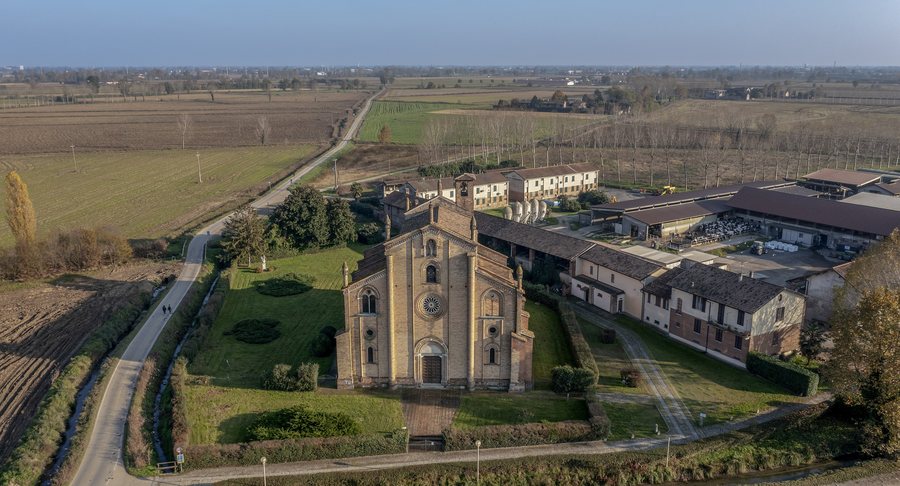 File:Lodi Vecchio - Basilica dei XII Apostoli - 2025-09-30 14-40-23 001.jpg
Photo: Maurizio Moro5153 via Wikimedia Commons, CC BY-SA 4.0
File:Lodi Vecchio - Basilica dei XII Apostoli - 2025-09-30 14-40-23 001.jpg
Photo: Maurizio Moro5153 via Wikimedia Commons, CC BY-SA 4.0
The Museo Laus Pompeia presents the history of the town through inscriptions and other finds from excavations in the 19th century, as well as from decades of archaeological digs. The museum is housed in an 18th-century building that was used for a long time as a stable and hayloft and forms part of the rural Corte Bassa complex. Ancient artefacts and the building’s later history of use thus come together in a shared historical context.
The archaeological site of Lodi Vecchio is located in Piazza Santa Maria. The piazza is considered the probable site of the Roman forum. Partially visible remains of the Roman theatre of Lodi Vecchio have been preserved along Via Giovanni XXIII. For a culture-focused exploration, this makes both a possible central square of the ancient town and traces of its theatrical architecture tangible.
Churches and Historical Building Phases
The Basilica dei XII Apostoli e di San Bassiano combines a datable historical testimony with impressive decoration: it was consecrated in mid-November 387, and its central walls and vaults are decorated with frescoes attributed to the Maestro di San Bassiano. The church building and the frescoes offer different ways of approaching the history of the structure.
The Ex Conventino also points to an earlier building phase: it stands on the remains of the Romanesque façade of the former Cathedral of Santa Maria. The earlier church, which is associated with the Basilica dei XII Apostoli e di San Bassiano, may have been the Basilica Apostolorum. The Basilica Apostolorum was built towards the end of the 4th century outside the walls of Laus Pompeia on the Via Emilia.
Discover Lodi and Lodi Vecchio by Bike
The cycle and walking path is designed to explore both modern Lodi and historic Lodi Vecchio. The route starts at Lodi railway station and reaches Lodi Vecchio via a short turn-off from the SP115. If you would like to combine the museum, archaeological remains and churches with both townscapes, this route offers a clear basis for planning without prescribing a fixed itinerary for the day.
When choosing a hotel or other accommodation for a culture-focused stay, you can make the museum, archaeology, churches or architectural history the main focus. The variety of themes allows you to plan a trip around your interest in the Roman past, religious architecture or historic traces in the town.
More Destinations
For your further travel planning, you can also include Maleo, Codogno, Montanaso Lombardo, Guardamiglio, Corno Giovine, Tavazzano con Villavesco, Caviaga and Boffalora D'adda in your plans.
For the higher-level travel overview: Lodi.

