
Vigevano between Renaissance, museums and the Ticino
Accommodation in Vigevano
Renaissance square and Castello
Vigevano combines impressive Renaissance architecture with museums, Leonardo da Vinci and paths through the countryside along the Ticino. At its centre is Piazza Ducale, a masterpiece of the Renaissance created in 1492–1494 at the behest of Ludovico il Moro. The square is also the main entrance to the Castello Visconteo-Sforzesco. The staircase beneath the tower leads into the castle courtyard.
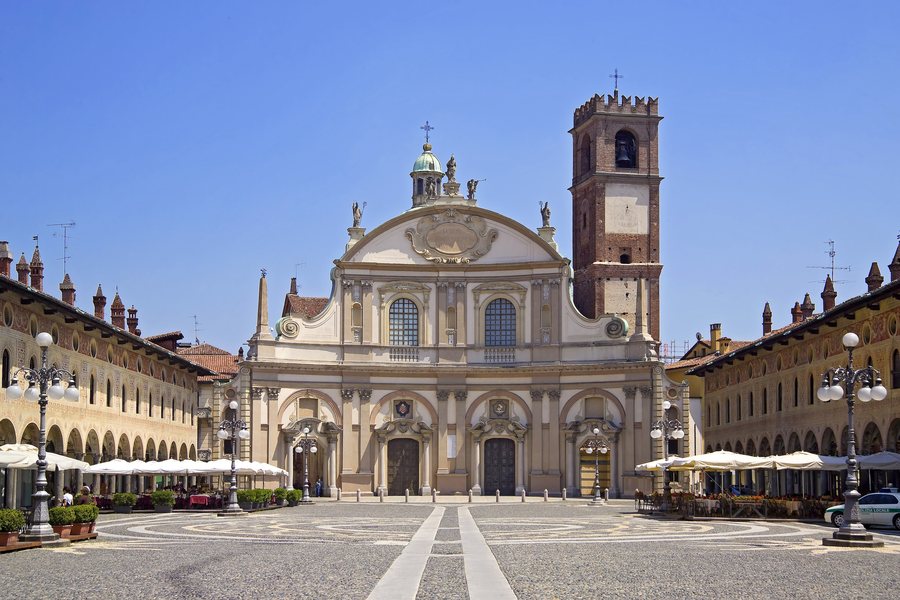 File:Vigevano Piazza Ducale il Duomo.jpg
Photo: Magagnini Carlo Alberto via Wikimedia Commons, CC BY-SA 4.0
File:Vigevano Piazza Ducale il Duomo.jpg
Photo: Magagnini Carlo Alberto via Wikimedia Commons, CC BY-SA 4.0
The Castello can be experienced from different perspectives. The Torre del Bramante can be climbed to the first row of battlements via approximately 100 steps. Guided tours of the Castello Visconteo-Sforzesco also include the interiors on Sundays and public holidays. In the halls of the Corte di Ludovico il Moro, Leonardiana presents the complete works of Leonardo da Vinci.
Museums covering industry, footwear and history
Vigevano’s museums give the city several clearly distinct cultural focal points. The Museo dell’Imprenditoria Vigevanese documents the city’s economic development from the late 15th century through the post-war period. Documents, images, objects and video reports are used for this purpose.
The Museo Internazionale della Calzatura is Italy’s only public museum dedicated to footwear. Vigevano Cathedral complements the architectural setting with an elliptical Baroque façade designed by Bishop Juan Caramuel y Lobkowitz. At the Museo Archeologico Nazionale della Lomellina, the chronological span extends from prehistory through Late Antiquity to the Early Middle Ages.
Leonardo, mills and paths along the water
The connection between technology, history and education continues beyond the castle. The Ecomuseo della Roggia Mora is located in the Mulino di Mora Bassa, a 15th-century mill with two large working water wheels. The family tour “A spasso con Leonardo e Ludovico” begins there with a guided tour followed by a workshop for children.
For a more tranquil experience of the countryside, the Anello delle Streghe circular route is ideal. It begins in Buccella, a district of Vigevano, and follows the embankment of the Ticino River to the Ramo delle Streghe. This slow-flowing side branch is characterised by aquatic plants; numerous bird, amphibian and reptile species find shelter there. The route is therefore particularly appealing to travellers who want to combine cultural activities with nature observation.
Getting there and choosing a location
For your travel planning, Vigevano is also accessible from Milan: the Trenord railway service runs approximately hourly, and the journey takes around 31–35 minutes. Vigevano railway station is approximately 700 metres, or a 10-minute walk, from Piazza Ducale. If you are considering a hotel in Vigevano as a base, these manageable distances and the combination of the square, castle, museums and countryside can provide helpful guidance when choosing the right location.
More destinations
More places for your travel planning: Settimo, Codevilla, Montescano, Val di Nizza, Salice Terme, Rocca De' Giorgi, Rovescala, Casteggio
To the broader travel overview: Pavia.

