
Montalenghe: Moraine Landscape and Medieval Traces
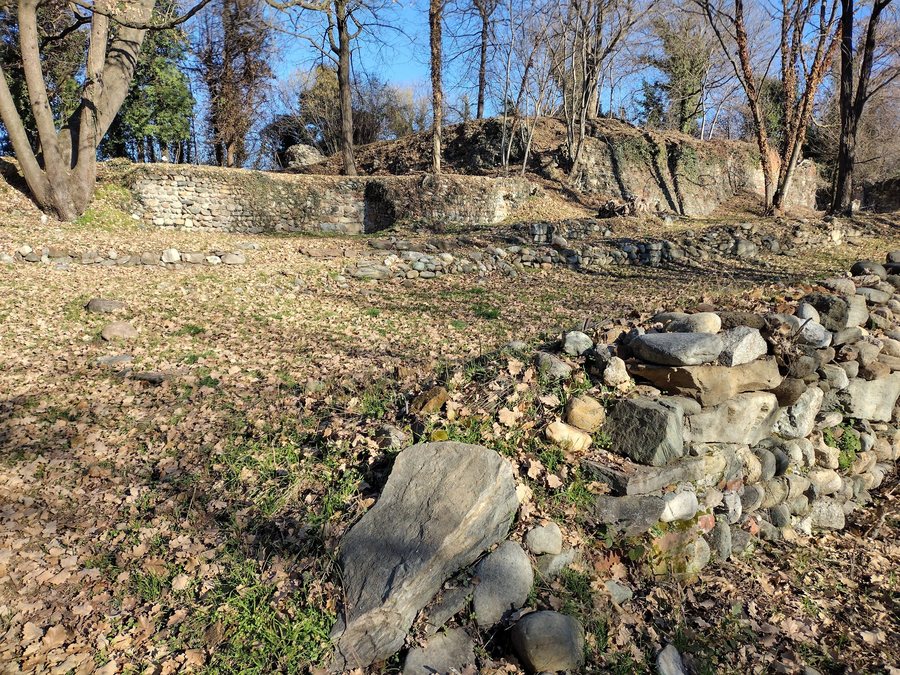
Montalenghe lies at the foot of the hill that forms the southern boundary of Ivrea’s imposing moraine amphitheatre. The terrain ranges from its lowest point at 280 metres to the hill’s summit at 436 metres. Its south-facing position offers views across the plain as far as the city of Turin.
A landscape of hills, forests and lakes
The Ivrea Moraine Amphitheatre is a glacial landform created by rock and soil debris deposited by a Baltic glacier. In the southern Gogliasso area of Montalenghe there are three lakes, fed mainly by spring water. In the forest on the moraine hill north of the town stands the Pietra del Vais, a glacial erratic.
The Sentiero delle Pietre Bianche highlights the Pietra del Vais as a distinctive feature of the moraine forests. For many generations, children have used the rock as a natural slide, and it serves as a place to rest in the forest of Montalenghe. Il Cedro di Montalenghe is among the municipality of Montalenghe’s group of monumental trees.
Hiking trails on different scales
The Sentiero delle Pietre Bianche consists of interconnected loops. Together, they pass through the territory of 11 municipalities in the provinces of Turin and Vercelli and include more than 50 kilometres of marked trails. In the moraine forests, the trail also highlights Montalenghe’s medieval castle, known as Castelvecchio.
For a clearly defined tour, there is the CAI loop Da Candia e Montalenghe sul sentiero delle Pietre Bianche. It is approximately 18 kilometres long, has around 300 metres of elevation gain, and is rated T in difficulty. The relevant section of Percorso 01 Dal Lago di Candia a Caluso, by contrast, follows a historic route that was once the only connection between Montalenghe and Orio.
For people walking the Sentiero delle Pietre Bianche, the Antica Fonte di Lussana is a place to stop and relax. However, it is difficult to access for people with motor disabilities. If you are planning a hike for people with different mobility needs, this limitation is important information to consider in your preparations.
Churches, castle hills and local history
The Chiesa di San Pietro is a cemetery church dating from the 13th century. Three plates on its façade indicate that the building was a station for passing pilgrims, who could find refreshments there. The Vasca del Broi is a water basin with a stone spring. It was used to water animals and collect water for irrigation in agriculture.
Roman finds have been discovered on the hill of Castelvecchio. The first evidence of the Castrum Montalengarum dates from 1181. The Priorato San Carlo complex includes a church and a theatre. Within a compact thematic area, Roman finds, the history of medieval fortifications, and sacred and cultural buildings thus come together.
Flavours and practical information
At Fungalenghe, porcini mushrooms are prepared according to traditional recipes. The festival’s particular speciality is its famous fried mushrooms. Free registration is required to borrow books from the library. Bus route 133 connects Torino, Foglizzo, San Giusto and Ivrea.
If you would like to compare Montalenghe with other places, you can also discover Val Della Torre, San Didero, None Turin, San Secondo Di Pinerolo, Riva presso Chieri, Vico Canavese, Vidracco and San Maurizio Canavese.
Back to the main travel overview: Turin.
Check prices, availability and amenities for your travel dates directly on Booking.com.
View accommodation and offersAdvertisement · Affiliate link to Booking.com
