
Pavone Canavese between the Castello and nature trails
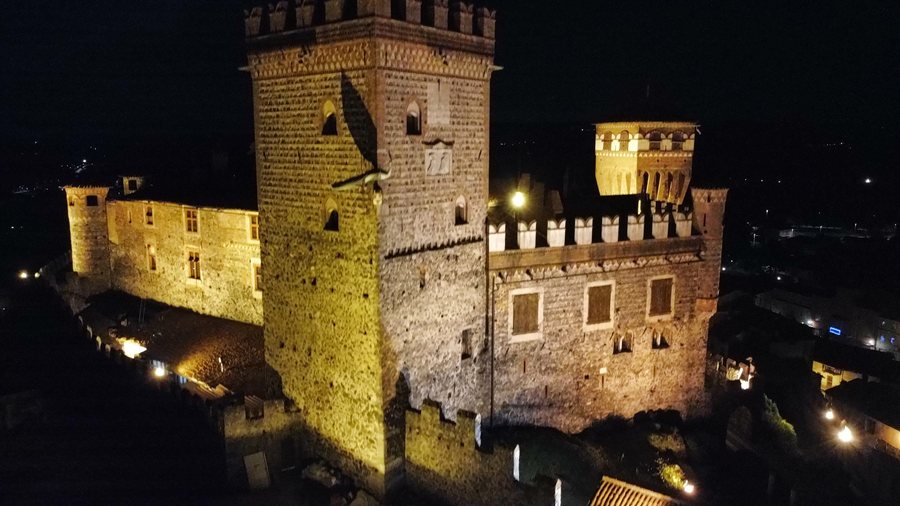 File:Pavone Canavese - Castello di Pavone Canavese - 2025-09-04 09-05-19 001.jpg
Photo: Jomillo via Wikimedia Commons, CC BY-SA 4.0
File:Pavone Canavese - Castello di Pavone Canavese - 2025-09-04 09-05-19 001.jpg
Photo: Jomillo via Wikimedia Commons, CC BY-SA 4.0
The Castello di Pavone, the Pavone Medievale nature trail and the trails of Paraj Auta offer three clearly distinct perspectives on Pavone Canavese: medieval architectural history, woodland and wetland landscapes, and paths through vineyards leading to a viewpoint. Added to these are churches, regional specialties and the Carnevale di Pavone – topics that can be explored side by side on an individually planned trip to Italy.
Castello, Ricetto and medieval churches
The Castello di Pavone originated in the 9th century as a fortified enclosure around a dioritic rocky outcrop. The complex served to protect the local population. Its defensive tower was probably built in the 11th century by the bishops of Ivrea. The castle’s history therefore extends from an early fortification to the region’s medieval power structures.
In 1870, the Castello di Pavone was expropriated by the Italian state. In 1885, Alfredo d’Andrade bought the castle for 7,000 lire and subsequently began the restoration work. The Ricetto was built on the same hill as the castle, to its west. The spatial relationship between the two structures is therefore one of Pavone Canavese’s specific historical features.
The religious buildings also add distinctive accents. The Chiesa della Madonna delle Grazie dates from the Middle Ages and became a pilgrimage site over time. Behind the altar is an 18th-century altarpiece depicting the Virgin Mary, a testimony to the church’s period of prosperity. The Chiesa di San Rocco is a national monument because of its elegant Baroque lines inside and its curved external forms.
Trails through woodland, vineyards and wetlands
The historic Pavone Medievale nature trail begins at the Torre Porta. Its route passes through centuries-old woods and small wetlands. Along the way are large glacier-smoothed rocks and hemispherical rock hollows. Medieval watchtowers belonging to the castle walls are also part of the route.
The trails of Paraj Auta first pass through well-maintained vineyards and then through deciduous forests on the southern slope of Truc Bunfurnera. At the turnoff for Sète d’la Madona, a glacial pothole, the landscape changes once again. From there, you reach a viewpoint overlooking the entire western pre-Alpine arc of Piedmont.
Products and festival culture
For 2025, the municipality of Pavone Canavese’s De.Co. register includes Salame della rosa, Salampatata, Toma di capra and Tomino di capra.
The Carnevale di Pavone normally takes place on the Sunday after the Carnival of Ivrea. The festival features the Castellani, pipers, marching bands, allegorical floats, horse riders, people in masks on foot and carriages.
A planned cycling link
The proposed Via Campestre is intended to connect the Paraj Auta trails in Pavone Canavese with the routes already recorded on the right lateral moraine of the Ivrea Moraine Amphitheatre in the areas of San Martino Canavese and Scarmagno.
More places for comparison
Vistrorio, Ceresole Reale, Champlas Seguin, Frassinetto, Roletto, Bobbio Pellice, Coazze, Rivalba
For the overarching travel overview: Turin.
Check prices, availability and amenities for your travel dates directly on Booking.com.
View accommodations and offersAdvertisement · Affiliate link to Booking.com
