
Fucine: Mining History, Churches and Cycling Route in Val di Sole
Accommodation in Fucine
Fucine is a settlement where river landscapes, mountains, architectural history and cycling come together. In Fucine, the Vermigliana stream flows into the Noce. Cima Boai is a peak in the vicinity of Fucine. Cima di Stavei is a mountain in the area around Fucine; Cima le Pozze and Cima Palù are peaks in the vicinity of Fucine. These connections open up different perspectives on the settlement for you: river, mountains, history and a route through Val di Sole.
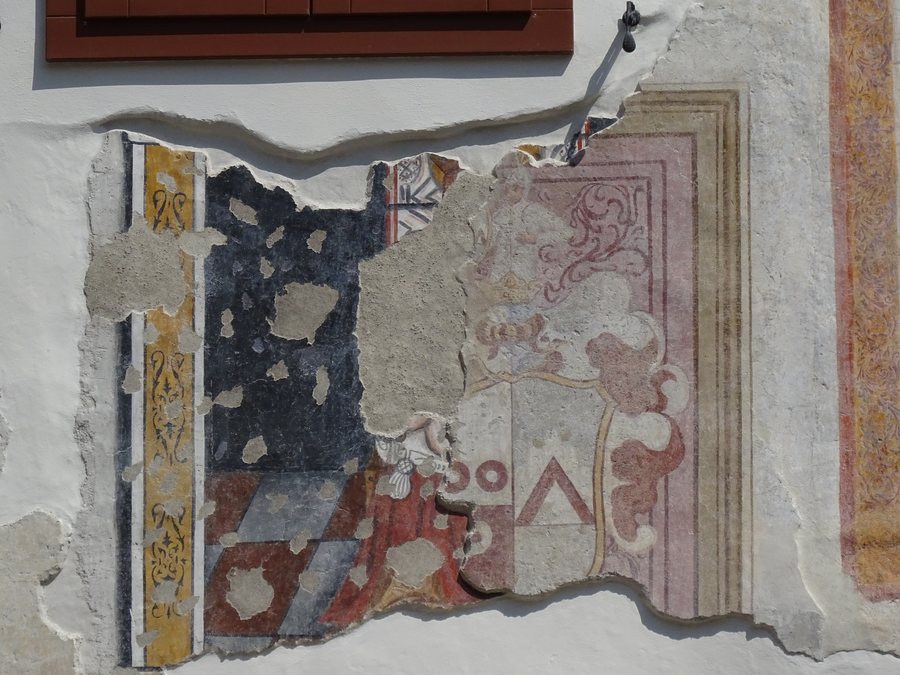 File:Fucine - Casa del dazio - Affresco frammentario.jpg
Photo: Syrio via Wikimedia Commons, CC BY-SA 4.0
A settlement with a history
The settlement of Fucine emerged from an exceptionally dense concentration of industrial facilities established between the late 14th and early 15th centuries as part of the exploitation of the ore deposits of Peio. This origin gives the settlement a historical focus that differs from the religious and architectural evidence of later centuries.
Churches and Casa del Dazio
The church of Fucine was rebuilt between 1902 and 1904 after the previous church building was destroyed by flooding in 1849. The Church of San Carlo Borromeo in Fucine dates from the 17th to the 20th century.
The Casa del Dazio building in Fucine preserves a significant façade painted in 1671 on behalf of the tax collector Carlo Busetti. The Casa del Dazio dates from the 17th century and has a sundial. The façade, period of construction and sundial make the building a tangible part of Fucine's architectural history.
Castles in the wider regional area
The cultural and historical surroundings extend beyond Fucine. Castello di Cles is a castle in the wider regional area around Fucine. Castel Thun is also a castle in the wider regional area around Fucine. The two castles therefore belong to the wider regional area around Fucine, not to the settlement itself.
Cycling through Val di Sole
The Pista Ciclopedonale della Val di Sole runs through Fucine. It extends for more than 30 kilometres from upper Val di Sole to Mostizzolo. After Fucine, it continues in a northwesterly direction into Val di Peio. For your route planning, Fucine therefore marks a section between upper Val di Sole, Mostizzolo and the continuation into Val di Peio.
Transport connections and regional events
The transport connections also differ: the Bike-Train service carries bicycles on the Mostizzolo–Mezzana section of the Val di Sole cycling route. There is a bus stop in Fucine on the Ponte di Legno–Ossana route. If you include the cycling route and the Ponte di Legno–Ossana route in your planning, you can consider these two transport connections separately.
Events complement the cultural themes. The historic Fiera di San Michele in Fucine includes an exhibition of crafts from the Val di Sole area. The Fera dei Sét is a traditional livestock fair in Ossana-Fucine. Thus, both craft culture and traditional market activity are central in Fucine and its regional surroundings.
When choosing a hotel or other accommodation in Fucine, you can focus on architectural history, cycling, transport connections, regional castles or events. This allows the settlement to be viewed as a travel component in its own right, while Castello di Cles and Castel Thun remain assigned to the wider regional area.
More destinations
San Martino Di Castrozza, Breguzzo, Soraga, Darzo, Vigo Di Fassa, Bolbeno, Comano Terme, Lenzi - Stefani
To the main travel overview: Trentino.

