
Pieve Di Bono: Sacred Art, Historic Sites and Trails
Accommodation in Pieve Di Bono
Pieve Di Bono between Sacred History and Landscapes
Pieve di Bono combines sacred art, historic traces of ruling powers, and paths through forests and rural landscapes. Those planning a trip with a cultural focus will find several clearly defined themes here. Pieve di Bono is one of the seven ancient pievi that made up the Giudicarie area. The Church of Santa Giustina dates from before 1200; its first documented mention is from September 5, 1221. The chapel of the parish church contains 15th-century frescoes in the Gothic-Giottesque style, created by Giovanni Badile.
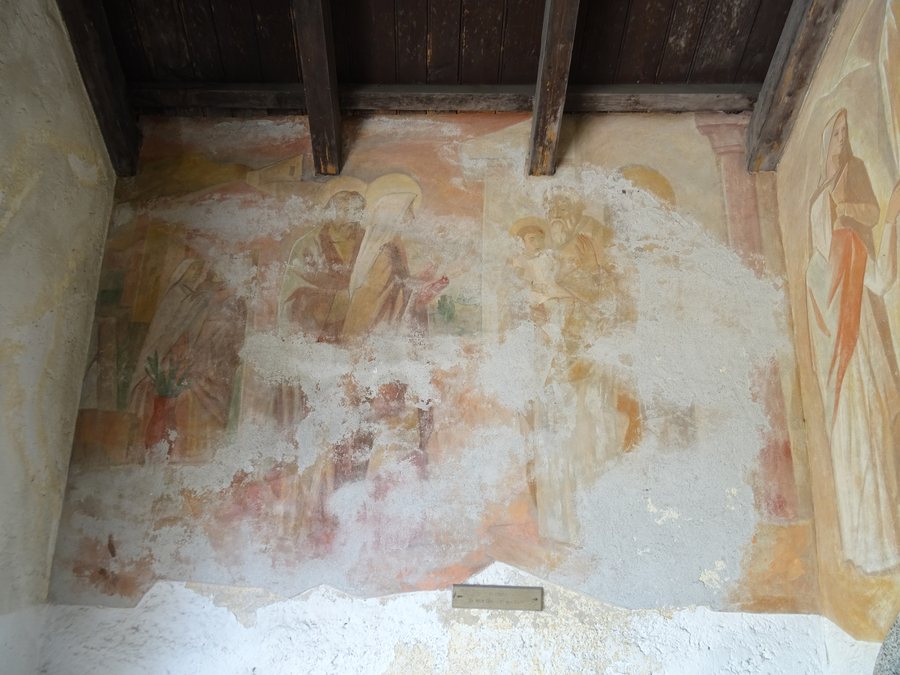 File:Pieve di Bono-Prezzo, cappella dell'Addolorata - Affreschi lati portico 01.jpg
Photo: Syrio via Wikimedia Commons, CC BY-SA 4.0
Castel Romano adds another historic focal point: it was the seat of the Lords of Arco and Lodrone. Castel Romano and its park date from 1253. The Sentiero Botanico winds through the forest and has an elevation difference of just under 100 meters. Its route continues to the area beneath the walls of Castel Romano. This means that a single trail focuses both on the forest passage and on views of the historic site.
The cultural picture also includes the historic rural building in Frugone (Agrone), which was the seat of the Magnifica Comunità Generale, as well as Forte Carriola and its Austrian fortifications, which are among the attractions of Pieve di Bono. The range thus extends from sacred art and the history of ruling powers to fortifications.
Trails through the Forest and Valle del Chiese
For an impression of the landscape, the Chiesetta di San Martino deserves separate consideration: its ruins offer beautiful views of the surrounding landscape and the Valle del Chiese below. This perspective adds a distinctly different viewpoint to the paths through forests and rural areas. If you would like to take nature, history and landscapes into account together when planning your trip, you can organize your days around these different experiences.
For cyclists, the Ciclovia della Valle del Chiese is a topic in its own right: it is about 37 kilometers long and leads to the Church of Santa Giustina in Pieve di Bono. At the same time, it is a good starting point for discovering traces of the First World War, such as communication trenches, trenches and positions. The route length provides a clear framework for the day, while the church destination creates a cultural connection. Those who do not want to consider cultural sites separately from physical activity can combine these two aspects in one itinerary.
The Pista Ciclabile Valle del Chiese Bondo-Baitoni offers a different type of route. It leads to Cologna, a hamlet of Pieve di Bono. Along the way, it alternates between sections of a cycle and pedestrian path and paved roads with little traffic. The route never crosses state or provincial roads. This sequence does not describe a uniform type of path, but rather an alternation between separate path sections and roads.
The Pista Ciclabile Valle del Chiese Bondo-Baitoni follows the course of the Chiese River, a tributary of Lago d'Idro, through beautiful rural landscapes. When choosing a hotel in Pieve Di Bono, you can derive a straightforward planning question from this: Should the focus of your stay be on sacred art and historic sites, a forest trail or cycling tours? Trails and cultural sites offer different points of connection, without requiring you to limit your stay to just one way of traveling.
More Destinations
Tret, Spital Bei Yfän, Comano Terme, Breguzzo, Località Produttiva I, Thenn, Romagnano, St. Pauls
To the overarching travel overview: Trentino.

