
Discover Vervò: landscapes, trails and culture
Accommodation in Vervò
Vervò between landscape and history
Vervò lies on a green terrace at the edge of the Predaia Plateau. In Vervò, trails through the landscape and cultural traces around San Martino showcase two distinct sides of the area. The Sentiero Romano and Sette Fontane pass through the landscape, while archaeological and ecclesiastical evidence can be found around San Martino.
Hiking along the Sentiero Romano
The Sentiero Romano begins in Vervò, more precisely in the hamlet of Verginaz, and leads to Mas del Mont. From a terrace, the route offers views over the lower Val di Non and the Brenta Dolomites. Along the way there is an equipped park with benches and fire pits. The Sentiero Romano also includes a small Tibetan bridge. A circular route follows the Sentiero Romano, first leading to Mas dal Mont and then to Malga di Vervò.
Sette Fontane and trails through the forests
The Sette Fontane route connects Vervò and Sfruz via forest roads through the spruce forests of Tovalin and Somassolo. A turnoff leads towards Predaia to the Sores Refuge; the route is also suitable for mountain bikes. Sette Fontane begins above Vervò, below the sports field, at an altitude of 960 m and crosses the Rio Sette Fontane over a wooden bridge after 1.7 km. The 1.7 kilometres to the wooden bridge form a specific section of the Sette Fontane route to include in your day’s planning. Another trail connects the hamlet of Vervò with the nearby Malga di Vervò of the same name.
Practical orientation in Verginaz
Verginaz has an equipped park with benches and fire pits, as well as panoramic views; parking is also available there.
Archaeology and the Church of San Martino
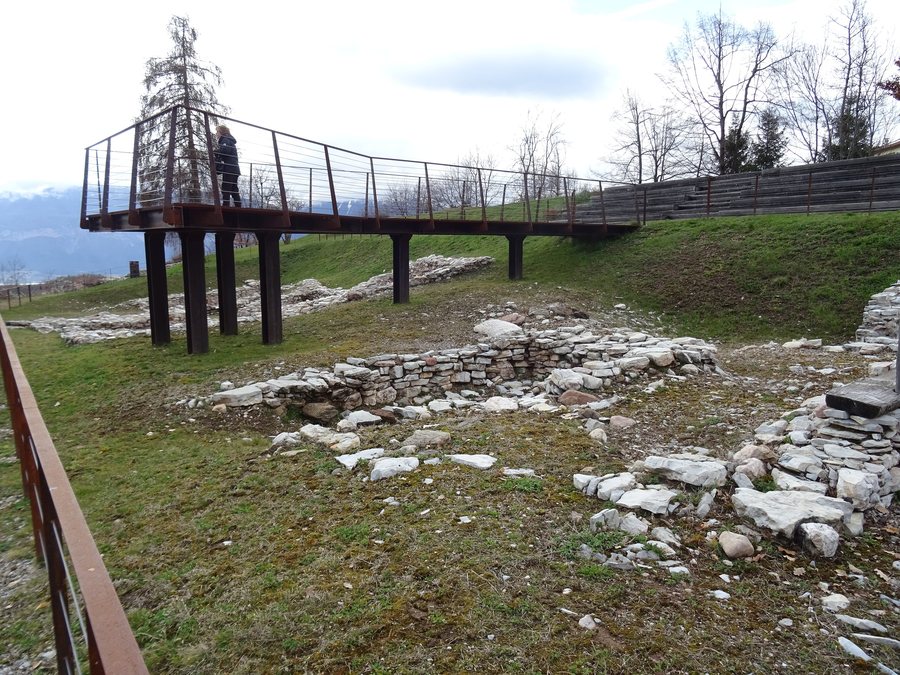
The archaeological area of San Martino di Vervò includes the 15th-century Chapel of Saints Fabian and Sebastian. In the same area, a settlement developed that is attributed to the Rhaetian or Fritzens-Sanzeno culture and existed from the middle of the 5th century to the 4th century BC. The traces of human presence found there range from prehistoric times to the Early Middle Ages. The settlement existed for a more limited period than the traces of human presence in the archaeological area of San Martino.
A picturesque road along the edge of the Pongaiola Gorge leads to the Church of San Martino. The bell tower bears a devotional fresco of Saint Christopher. The old Church of San Martino has been rebuilt since the 16th century and features several historical and artistic characteristics. Seventeen Roman inscriptions have been found in Vervò. There are also recurring frescoes with sacred depictions, sundials and coats of arms.
Discover other places
If you would like to expand your travel selection: Canazei, Penia Di Canazei, Cogolo, Canal San Bovo, Vetriolo, Fiavè, Daone and Selva Di Levico.
For the broader travel overview: Trentino.

