
Frassine: Pilgrimage, Art and History
Accommodation in Frassine
Frassine combines a complex settlement history with religious tradition and tangible traces of the past. The Santuario della Madonna del Frassine remains a pilgrimage destination, particularly on 25 April, the feast of the Madonna del Frassine. The local history, art and religious practices thus offer several points of connection for travelers who want to understand Italy beyond mere place names. When choosing accommodation for your trip to Italy, Frassine’s religious and historical highlights can serve as a personal benchmark.
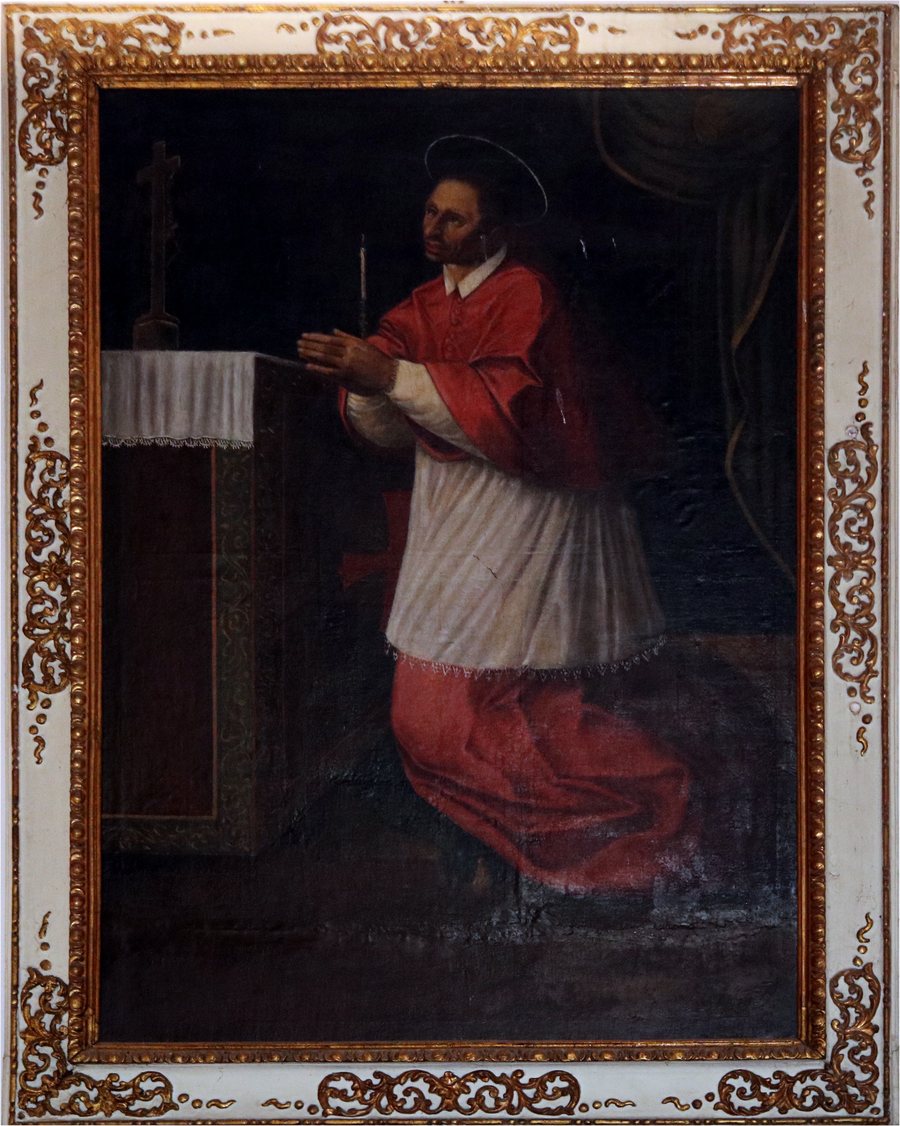 File:Santuario della Madonna del Frassine (Monterotondo Marittimo), San Carlo Borromeo davanti al Crocifisso.jpg
Photo: Mongolo1984 via Source, CC BY-SA 4.0
File:Santuario della Madonna del Frassine (Monterotondo Marittimo), San Carlo Borromeo davanti al Crocifisso.jpg
Photo: Mongolo1984 via Source, CC BY-SA 4.0
Pilgrimage and Sacred Art
The Santuario Nostra Signora del Frassine is open daily from 9:00 a.m. to 7:00 p.m. Next to the Santuario della Madonna del Frassine is the Casa del Pellegrino, a reception building used independently during the day, with a kitchen and dining room.
The Santuario della Madonna del Frassine also houses a wooden statue of the “Vergine col Bambino.” It is attributed to an artist of the Pisan school of the 14th century who remains unknown to this day. This attribution links the work to 14th-century Pisan art without naming an artist. This creates a distinctive cultural and historical connection between a religious site, medieval sculpture and uncertain authorship.
History from Gualdo del Re to Frassine
Frassine was established in the 6th century under the name Gualdo del Re as a Lombard settlement. Around the year 1000, the name Frassine appears for the first time. The Santuario della Madonna del Frassine was built on the ruins of the former Santa Maria in Frassineto church; the earlier church is already documented for the 14th and 15th centuries. For your travel planning, this sequence opens up several distinct chronological approaches to the history of the place.
Frassine is home to the partisan memorial “Cippo ai caduti di Frassine.” In addition, a sulfur quarry operated in Frassine approximately from 1500 to 1600. These two traces supplement the sacred history with political remembrance and an earlier use of the area. For travelers interested in cultural history, this creates a picture in which religious, social and economic pasts stand side by side.
Bagni del Re and the Surrounding Landscape
The Bagni del Re are located in the vicinity of Frassine, on the plain between the Cornia River and the hill of Frassine, along the Fosso Malguado. The site, comprising three buildings, included thermal springs. Its geographical setting connects the history of the Bagni del Re with a landscape consisting of a plain, river, hill and watercourse.
The Museo dei miracoli
The same area is home to a small “Museo dei miracoli” with numerous painted panels from the 19th century. The panels provide another cultural accent within the religious and historical setting. If you would like to combine sacred art, local history and traces in the landscape, Frassine offers several distinct themes for a thoughtfully planned trip.
More Destinations for Orientation
For further orientation, you can also explore Sabatina, Le Rocchette, Castiglione Della Pescaia, Salaiola, Borgo Carige, Monte Argentario, La Dispensa and Castel Del Piano.
For the overarching travel overview: Grosseto.

,_San_Carlo_Borromeo_davanti_al_Crocifisso.jpg)