
Sulmona: History, Culture and Confetti
History and Architecture in Sulmona
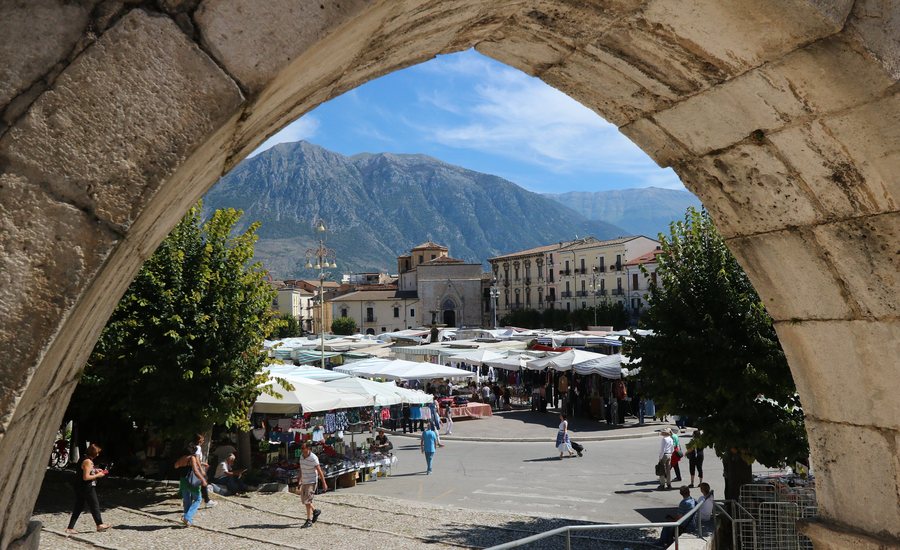
If you would like to get to know Sulmona through its history, an important starting point is the Acquedotto Medioevale. The medieval aqueduct was built in 1256 during the rule of Manfred of Swabia. The structure channelled water from the Gizio River to irrigate the city gardens, power mills and workshops, and supply the city's fountains.
The Complesso della Santissima Annunziata also combines different historical and artistic layers. The complex consists of a church and an adjoining palace and brings together centuries of history and various forms of artistic expression. The church features Baroque forms resulting from a reconstruction that began in 1710.
The Eremo di Sant'Onofrio adds a place that closely connects history and landscape. The hermitage was founded in 1293 by Pietro Angelerio, the future Pope Celestine V. It is situated 600 metres above sea level on a steep cliff overlooking the Conca Peligna. A footpath to the site takes approximately 20 minutes on foot. The Abbazia celestiniana di Santo Spirito a Morrone was founded around the middle of the 13th century at the foot of Monte Morrone on the initiative of the future Pope Celestine V.
Museums between Art, Everyday Life and Craftsmanship
For visitors interested in culture, Sulmona offers several different approaches. The Polo Culturale Civico Diocesano di Santa Chiara – Museo Diocesano di Arte Sacra houses works of art from the 12th to the 19th century. These include panel and canvas paintings, stonework, wooden sculptures, goldsmithery, codices and textiles.
The Polo Museale Civico della Santissima Annunziata – Museo del Costume Popolare Abruzzese e Molisano e della Transumanza presents local ethnography through prints, traditional costumes and everyday objects mainly associated with shepherding. The Museo dell’Immagine e delle Tecniche Fotografiche also includes a section on Sulmona's history and local traditions from 1840 onwards, illustrated by historical photographs.
Confetti as a Special Part of the City's Culture
The Museo Pelino dell’Arte e della Tecnologia Confettiera offers a unique combination of craftsmanship, flavour and local tradition. It contains historical patents from the Pelino factory, awards, sugar boxes from the 19th and 20th centuries, and artistic compositions made of Confetti. The museum also reconstructs an 18th-century confectionery workshop with original machines for producing and processing Confetti.
Confetto di Sulmona consists of a whole, peeled almond at its centre, coated with several layers of sugar applied one on top of another. The tradition of making Confetti di Sulmona has ancient origins and has been documented throughout the centuries. This makes the confectionery tradition one of the subjects through which Sulmona can be explored particularly vividly.
Hiking Trail and Historical Remembrance
If you would like to combine culture with a longer hike, the Sentiero della Libertà is a clearly defined focus. The hiking trail is approximately 60 kilometres long and is completed in three stages over three days. It follows the route used by Allied prisoners and young Italians after 8 September 1943 in the struggle to liberate Italy. Its approximate length and division into stages help you plan this topic differently from a short visit to individual museums or buildings.
Modern urban culture also includes the Giostra Cavalleresca. At this event, riders representing Sulmona's city districts compete in speed and ring-jousting contests. Thus, in Sulmona, historic architecture, religious art, everyday history, Confetti and a modern equestrian event exist side by side, without having to form a single visiting programme.
Getting There and Choosing Your Stay
Sulmona can be reached by train from Rome and Pescara. When choosing a hotel, you can therefore align the focus of your stay with the subjects that interest you most: the buildings and museums, the history of Confetto di Sulmona or the approximately three-day Sentiero della Libertà.
Check prices, availability and amenities for your travel dates directly on Booking.com.
View Accommodation and OffersAdvertisement · Affiliate link to Booking.comFurther Destinations for Planning Your Trip
If you would also like to consider other places in the same destination, Sant'Eusanio Forconese, Roccacasale, Spineta, Corfinio, Meta, Balsorano Nuovo, Poggio Picenze and Capistrello are among the other available travel destinations.
For the higher-level travel overview: L-Aquila.

