
Buddusò between Granite Landscapes and Nuragic Culture
Accommodation in Buddusò
Buddusò combines a striking granite landscape with traces of different cultural periods. Around the town, granite formations feature cavities created by erosion, known as tafoni or, in Sardinian, concheddas. The landscape is also characterised by white granite quarries, grazing land, cork oak forests and dense Mediterranean maquis. Granite therefore represents both the natural formations around Buddusò and visible elements within the town. Prehistoric sites, a Baroque church and museums add further tangible cultural themes to the landscape.
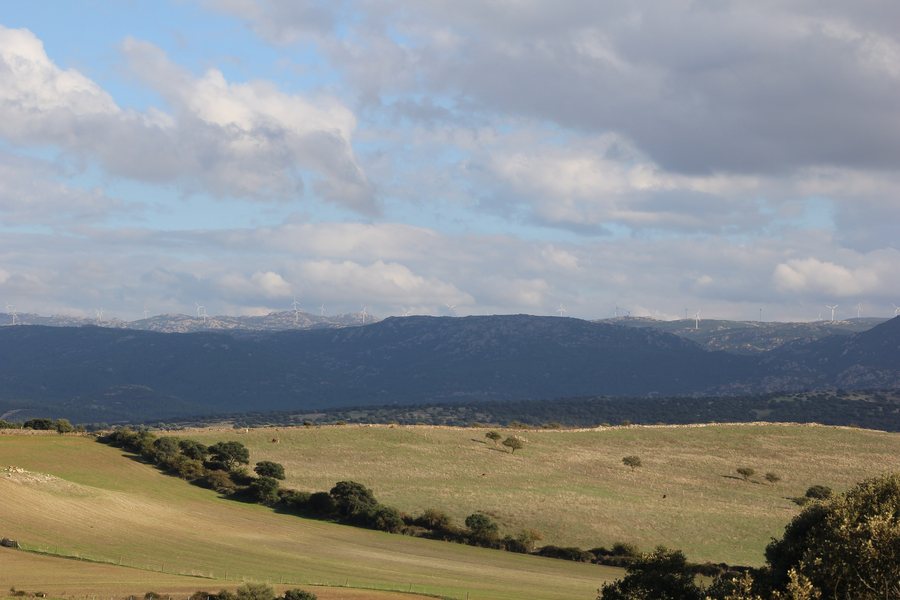 File:Alà dei Sardi - Buddusò, parco eolico (01).JPG
Photo: Gianni Careddu via Wikimedia Commons, CC BY-SA 4.0
File:Alà dei Sardi - Buddusò, parco eolico (01).JPG
Photo: Gianni Careddu via Wikimedia Commons, CC BY-SA 4.0
Granite formations, quarries and the townscape of Buddusò
At the Museum of Contemporary Art, granite itself becomes the subject of art. Granite works are displayed in the museum's outdoor park and at several locations in the historic centre of Buddusò. The material thus appears in different places and in various forms. Su Palattu adds to this impression as a multi-storey building in Buddusò constructed from visible or only roughly hewn granite blocks. Between the reliefs, exhibited works and building façades, stone remains a recurring element of the local experience.
Nuraghe Loelle, Ludurru and prehistoric traces around Buddusò
The necropolis of Ludurru lies about 200 m from the north-eastern edge of Buddusò. At Nuraghe Loelle, the architectural form takes centre stage: the nuraghe is of the mixed type, combining features of corridor nuraghi and tholos nuraghi. It consists of a central tower with a three-lobed bastion. A large settlement with round huts extends around Nuraghe Loelle; two giants' tombs are also located nearby. The prehistoric landscape therefore encompasses both the nuraghe itself and settlement and burial structures in its vicinity.
San Quirico in Buddusò, archaeological sites and regional museums
The Church of San Quirico in Buddusò is a Baroque church. Romanzesu, an archaeological site, lies in the surrounding area. The wider region around Buddusò also includes Fonte Sacra Su Tempiesu, likewise an archaeological site, as well as the Native House and Museum of Grazia Deledda and the Museo Archeologico Nazionale Giorgio Asproni, two museums. For those interested in culture, sacred architecture is complemented by archaeological sites and museums linked by the same theme.
Mountains near Buddusò: Punta Carreri, Punta Covecada, Monte sa Mesa and Punta Lattari
The mountains of Punta Carreri, Punta Covecada, Monte sa Mesa and Punta Lattari lie in the area around Buddusò. Their names are just as important for geographical orientation as the granite quarries and natural areas surrounding the town. Grazing land, cork oak forests and dense Mediterranean maquis form the landscape's setting. Thus, even beyond its cultural sites, Buddusò remains characterised by a clearly recognisable connection between granite, mountains and Mediterranean vegetation.
More destinations: Nuragheddu, Costa Serena, Le Vecchie Saline, San Pasquale, Bortigiadas, Maiorca, Pantogia and Pittulongu.
For the main travel overview: Olbia-Tempio.

.JPG)