
Nuchis: Churches, Granite and the Itinerario 39 Cycle Route
Accommodation in Nuchis
Nuchis between Local History and the Gallura Landscape
During the 16th and 17th centuries, Nuchis developed and took in refugees from coastal towns that had been attacked by Barbary corsairs. This history can be explored alongside sacred art. The parish church of Chiesa dello Spirito Santo in Nuchis is dedicated to the Holy Spirit, Spirito Santo, and preserves a painting by Giovanni Marghinotti from the late 19th century depicting the Descent of the Holy Spirit.
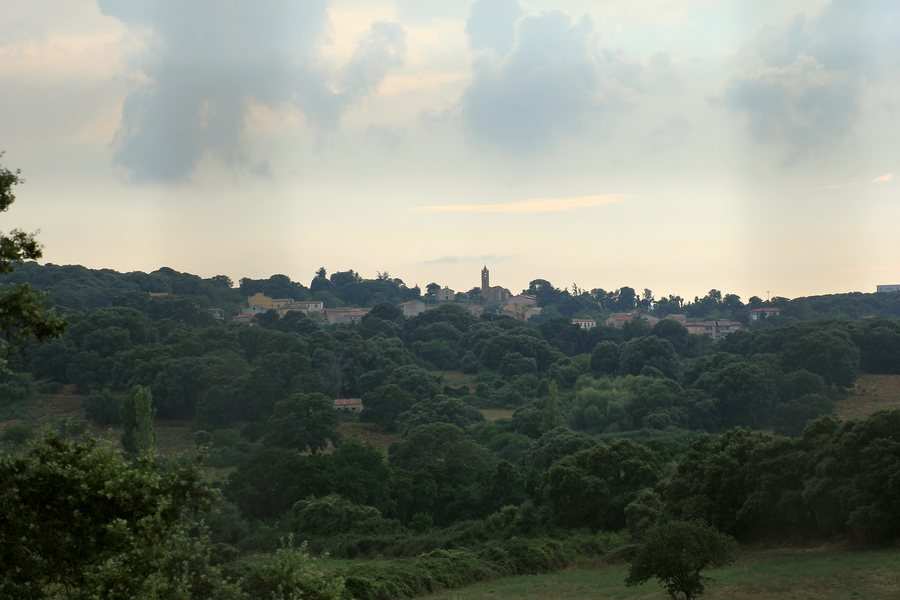 File:Tempio Pausania, frazione Nuchis, panorama (01).jpg
Photo: Gianni Careddu via Wikimedia Commons, CC BY-SA 4.0
File:Tempio Pausania, frazione Nuchis, panorama (01).jpg
Photo: Gianni Careddu via Wikimedia Commons, CC BY-SA 4.0
Stone, Frescoes and Mountainous Surroundings
The Santi Cosma e Damiano sanctuary is now used as an oratory. It was founded in 1529 after a plague, rebuilt in 1835 and restored in 1945. Built entirely of granite, the sanctuary has a façade with sloping rooflines and a bell gable. The single-nave interior is divided by five arches that structure a barrel vault; the sanctuary also contains frescoes by Carlo Armanni. It stands in a garden amid the landscape of the Gallura mountains. Its foundation, reconstruction and restoration mark three distinct points in the building's history.
Other Churches and Oratories
The Church of San Salvatore is built entirely from exposed granite blocks and is located near the edge of town on Corso Vittorio Emanuele. The Oratorio della Santa Croce has a façade with a bell gable and a single-nave interior divided into two bays by a chancel arch. The oratory of the Church of del Purgatorio was founded in the first half of the 18th century by Giovanni Piga, the rector of Nuchis. The Church of del Purgatorio has a gabled façade with a bell gable and a single-nave interior.
Architecture in Comparison
The buildings can also be compared through shared details: Santi Cosma e Damiano, Santa Croce and del Purgatorio each have a bell gable. Their single-nave interiors are arranged differently: five arches divide the barrel vault of Santi Cosma e Damiano, while Santa Croce is divided into two bays by a chancel arch.
Itinerario 39 for Cycling Trips
The Itinerario 39 cycle route passes through Nuchis and then branches off towards Calangianus. It partly follows the disused Monti–Tempio railway line, most of which has been converted into a cycle route. The Itinerario 39 runs between Monti/Telti railway station and Tempio Pausania and passes through the forests of Monte Limbara. For cycling travellers, the Itinerario 39 thus combines the route through the town, a former railway line and a wooded mountain landscape. When planning your route, distinguish the branch towards Calangianus from the continuation of the route between Monti/Telti and Tempio Pausania.
Travel Planning with Culture and Exercise
The churches, the sanctuary and the Itinerario 39 cycle route passing through Nuchis appeal to different interests: you can focus on granite architecture, spatial details, frescoes and local history, or include the cycle route as part of your further plans for the day.
More Places for Travel Planning
For your further travel planning, you can also consider Luddui, Monti, Cannigione, Aglientu, Capannaccia, Bortigiadas, Muntiggioni and Agrustos.
For the higher-level travel overview: Olbia-Tempio.

.jpg)